
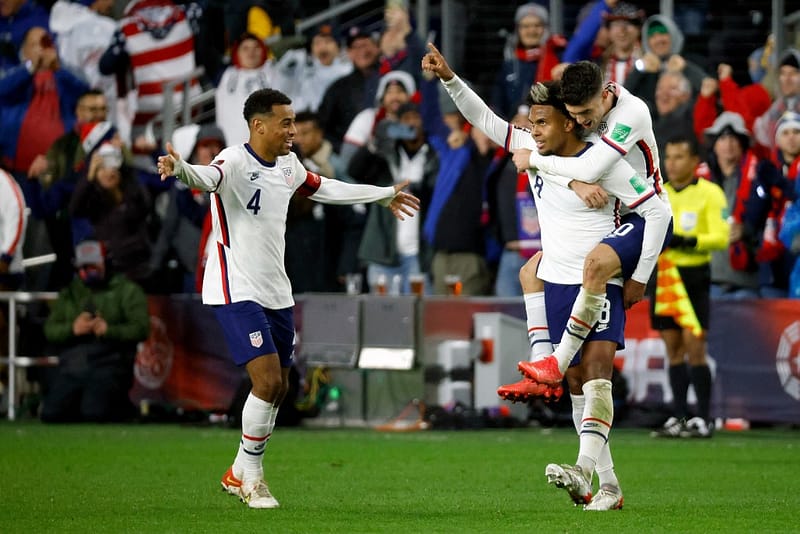

Ricardo Pepi’s 2026 World Cup story has become more than a redemption arc. For the United States men’s national team, his return to a central role gives Mauricio Pochettino a tactical option that changes how opponents must defend the host nation. The shift to a two-striker setup with Pepi and Folarin Balogun against Australia did more than cover for Christian Pulisic’s absence. It gave the USMNT a clearer way to press center backs, occupy the penalty area, stretch a back line, and create chances without asking one star attacker to carry every attacking rhythm.
Why Pepi’s Return Changes The USMNT Attack
Pepi’s place in this World Cup cycle carries weight because of what came before it. The El Paso native missed the 2022 World Cup roster, then rebuilt his national-team value through club production, movement, and sharper work around the box. U.S. Soccer’s pre-tournament striker breakdown noted that Folarin Balogun, Haji Wright, and Ricardo Pepi entered camp after combining for 56 goals across all club competitions in the 2025-26 season, with Pepi scoring 19 goals in 34 matches for PSV Eindhoven.

That profile matters for a USMNT side trying to reach a higher tournament level at home. Pepi is not simply a penalty-box finisher who waits for service. His best value in Pochettino’s system comes from the way he reads space, presses defenders, and gives midfielders a target between the lines or beyond the last center back. Pochettino described him through that lens before the tournament, praising his ability to find scoring positions and create chances from difficult situations in U.S. Soccer’s official striker preview.
The revival is tactical as much as emotional. Pepi gives the U.S. a second true striker who can play beside Balogun rather than only serve as his substitute. That changes the rotation math, the pressing triggers, and the way opponents prepare for the Americans in knockout play.
How The Balogun-Pepi Pairing Stretched Australia
The Australia match showed why Pochettino may keep the two-striker idea in his tournament toolkit. With Pulisic unavailable, the easy move would have been to replace him with another attacking midfielder and keep the familiar structure intact. Pochettino went in a different direction, moving away from the usual 3-4-2-1 possession shape and using a 3-5-2 that placed Pepi beside Balogun.
That decision gave the U.S. two central runners against Australia’s back line. Balogun’s pressure helped create the early own goal from Cameron Burgess, and Pepi’s movement kept Australia’s center backs from stepping into midfield cleanly. MLSsoccer’s match analysis described how Pochettino shifted into a 3-5-2, brought Pepi in to partner Balogun, and watched the pair disturb Australia’s defensive shape during the 2-0 win that sent the U.S. into the knockout stage as Group D winner.
The internal connection is clear from the same match. World Football Idol already broke down how Pochettino’s World Cup plan looked more convincing after the Australia result, and Pepi’s role is one of the strongest reasons that analysis now has a deeper tactical layer.
A two-striker system makes the U.S. less predictable. It gives Weston McKennie, Tyler Adams, Malik Tillman, Sergiño Dest, and Antonee Robinson more direct forward options. It can pin three center backs, split two center backs, or force a defensive midfielder to choose between tracking a striker dropping off or protecting space in front of the box.
Why Pochettino’s Shift Is About More Than One Match
The USMNT’s attacking questions have often centered on individual talent. Can Pulisic break the game open? Can Balogun finish the biggest chance? Can Gio Reyna control tempo? Can Tim Weah stretch the right side? Those questions still matter, but the two-striker shape changes the frame. It asks whether the U.S. can create repeatable pressure through structure rather than waiting for isolated moments.
That distinction is central to Pochettino’s tournament management. A host nation with knockout ambitions cannot survive only through emotion, home crowds, and transition play. It needs a way to win field position, wear down opponents, and generate second balls in dangerous areas. Pepi’s off-ball work helps that effort because he can close passing lanes, start the press, and force rushed clearances that keep the U.S. attack alive.
| Tactical Area | What Pepi Adds | Why It Raises The Ceiling |
|---|---|---|
| Central Pressing | A second striker to pressure center backs | Opponents get less time to build through the middle |
| Penalty-Area Presence | Another runner attacking gaps | Balogun is not isolated against multiple defenders |
| Line Stretching | Runs behind the back line | Midfielders gain more forward passing lanes |
| Rotation Flexibility | Can start, rotate, or close matches | Pochettino can manage minutes without losing striker threat |
That is why Pepi’s performance does not need to be judged only by shots, touches, or goals. Against compact teams, a striker’s value often appears in the moments before the chance: the curved press, the near-post run that pulls a defender, the duel that prevents a clean clearance, or the angle that gives a midfielder a safer forward pass.
What The Türkiye Match Can Reveal Before The Knockouts
The United States has already secured its path out of Group D, but the June 25 local-time group finale against Türkiye at SoFi Stadium still carries tactical value. FIFA lists the fixture in Los Angeles, and SoFi Stadium’s event page gives fans the local matchday structure, with parking lots opening at 3 p.m., gates at 4 p.m., and kickoff at 7 p.m. Pacific Time through the stadium’s Türkiye-USA event information.

For Pochettino, the question is not only who starts. It is how much evidence he wants before the knockout round. Does Pepi get another extended run with Balogun? Does the staff test the same 3-5-2 with different midfield support? Does Pulisic return into a system that now has another viable attacking shape? Those decisions could shape how the U.S. approaches opponents that defend deeper, press higher, or concede possession.
The best version of this USMNT may not be one fixed lineup. It may be a team with two credible attacking identities: one built around Pulisic’s ability to combine and attack from wide or half-space positions, and another built around Pepi and Balogun pressing and occupying central defenders. Tournament teams need that kind of flexibility when matchups change every few days.
Why Pepi’s Revival Could Redefine The Knockout Blueprint
Pepi’s World Cup revival matters because it gives the U.S. a more layered route through the tournament. He does not need to replace Pulisic’s creative weight or Balogun’s lead-striker status. His value comes from expanding the shape of the attack, making Pochettino’s decisions harder for opponents to predict, and giving the USMNT a direct central presence that can survive physical knockout matches.
For World Football Idol readers, this is the player-story version of a larger tactical shift. Pepi’s comeback is compelling on its own, but the bigger story is what his role allows the team to become. A two-striker U.S. does not have to abandon width, pressing, or transition speed. It can use those traits with more central occupation and a stronger first line of pressure.
The knockout stage will test whether the Australia performance was a useful one-match solution or the beginning of a new tournament identity. If Pepi and Balogun continue to make defenders uncomfortable, Pochettino’s ceiling with this group rises. The U.S. would no longer look like a team waiting for its biggest names to solve every hard moment. It would look like a side with tactical answers, striker depth, and a forward partnership capable of changing how the rest of the World Cup prepares for the host nation.