
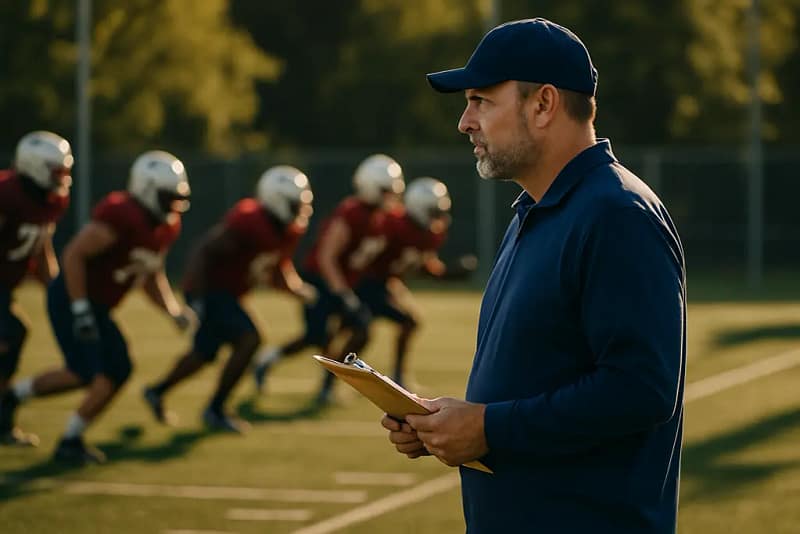

NFL Coaching Strategies were already clear by August 20, 2026: coaches used training camp less as a motivational stage and more as a controlled evaluation period. The strongest themes were workload management, early installation for rookies and quarterbacks, selective physicality, and a greater willingness to treat practice mistakes as useful teaching evidence rather than simple failure.
The timing matters. Training camps had fully opened by late July, so the early camp decisions are no longer theoretical. They were observable choices made before preseason evaluation narrowed rosters and exposed depth-chart pressure. That makes the first weeks of camp useful for judging how staffs balanced urgency with player preservation.
Camp Calendar Set The Evaluation Window
Report Dates Created A Compressed Start
The Arizona Cardinals and Carolina Panthers had rookies and veterans report on July 22, 2026, and all 32 teams had officially reported by July 28, 2026, according to the NFL’s training camp report dates. That schedule gave staffs only a short runway before August preseason work began to influence roster decisions.
A compressed camp start tends to reward coaches with a clear teaching order. Installation, conditioning, position battles, and special-teams evaluation all compete for practice time. A staff that overloads the first week can lose clean execution. A staff that moves too slowly can delay live evaluation. The best camp plans usually reveal themselves by how well they stage those priorities rather than by how forcefully coaches talk about them.
Early Arrivals Reflected A Teaching Priority
One notable 2026 trend was the revived use of early arrivals for rookies, quarterbacks, and selected players returning from injury. Kansas City reinstated a rookies-and-quarterbacks crash course before full camp reporting, a choice framed around reps and cohesion after a 6-11 season. That approach is practical. Quarterbacks need timing with route concepts, rookies need procedural fluency, and coaches need to identify mental errors before veterans join full-speed sessions.
Early arrivals do not guarantee cleaner football. They do, however, create a controlled learning block before the roster becomes crowded. For young players, that can separate a correctable mistake from a repeated assignment problem. For coaches, it creates a better baseline before padded practice exposes physical and technical gaps.
How NFL Coaching Strategies Changed Camp Workloads
NFL Coaching Strategies And The Jets Model
The clearest workload example came from the New York Jets under Aaron Glenn. The Washington Post reported on July 31, 2026, that the Jets used analytics, sports science, and rest periods while alternating high-rep practice days with recovery days. Their plan gradually raised workload peaks from about 24 reps in Week 1 toward about 40 in later weeks, according to the Jets camp workload plan.
That model shows how NFL Coaching Strategies have shifted from simple toughness markers toward load sequencing. The relevant question is not whether a practice is hard. It is whether hard work arrives at the right point in the ramp-up. If a team wants starters to peak in later camp periods, the first week cannot be treated like a finished regular-season practice week.
Glenn’s approach also fit his public back-to-business tone. Research from Washington Post reporting described his emphasis on measurable improvement and accountability rather than slogans or hype speeches. That matters because a science-led camp can still lose credibility if players hear vague messaging. The Jets’ plan paired a measurable workload structure with a direct standard for daily improvement.
Contact Levels And Injury Risk
Pittsburgh’s approach under Mike McCarthy offered a different version of the same balancing act. The Steelers moved toward thud-level physicality, meaning contact without full tackling, to keep intensity while reducing injury exposure. That is not a soft camp by default. It is a choice to practice body position, fit, tempo, and physical intent without turning every period into a tackling drill.
Denver’s early camp reports moved the injury-risk discussion in another direction. Sean Payton expressed frustration on August 10, 2026, over soft-tissue injuries, including hamstring and groin strains, during early practices. Those concerns point to a different evaluation layer: the quality of pre-practice routines, conditioning work, recovery timing, and individual readiness.
For roster analysis, that distinction matters. A player missing practice because of a soft-tissue issue loses reps, but the larger coaching question is whether the staff’s workload design is preventing repeat problems. No responsible analysis should diagnose those injuries from outside the building. The relevant camp takeaway is that availability management became part of coaching performance, not a side issue.
New Staffs Used Camp To Set Standards
Ten New Head Coaches Raised The Stakes
AP reported on July 21, 2026, that 10 NFL teams entered training camp with new head coaches. The group included Mike LaFleur in Arizona, Kevin Stefanski in Atlanta, Robert Saleh in Tennessee, and Mike McCarthy returning to Pittsburgh. That volume of turnover made camp a leaguewide test of message discipline and teaching clarity.
New coaches often inherit more than roster questions. They inherit practice habits, leadership structures, communication patterns, and sometimes the residue of losing seasons. Tennessee’s camp under Robert Saleh was framed around urgency after back-to-back 3-14 seasons, with Saleh and general manager Mike Borgonzi emphasizing measurable improvement rather than predictions. That was a useful posture. A rebuilding camp can lose focus if optimism replaces evidence.
Arizona, Atlanta, Tennessee, and Pittsburgh did not face identical problems, so their camps should not be graded by one standard. A new offensive staff may prioritize timing and terminology. A defensive-minded coach may care first about pursuit, alignment, and communication. A veteran coach returning to a familiar franchise may use camp to re-establish practice identity. The common issue is whether standards become visible in the daily structure.
Mistakes Became Teaching Evidence
Miami’s Jeff Hafley made a young roster’s mistakes part of the plan. Research from AP reporting described Hafley’s interest in seeing mistakes during camp, with players pushed outside comfort zones before preseason work. That is a sound developmental principle if the staff can separate productive errors from repeated mental lapses.
There is a difference between tolerating errors and accepting poor practice. A young receiver running a route at full speed and learning the adjustment is not the same as a missed assignment that recurs after correction. Coaches who value mistakes need tracking systems, clear feedback, and enough repetition for learning to stick. Without that, mistake tolerance can become vague permission for sloppy football.
Roster Evaluation Became More Conditional
Sloppy Starts Needed Context
Jacksonville’s Jared Coen described Week 1 of camp on July 29, 2026, as a bit sloppy, especially with drops and inaccuracy before full contact began. He also emphasized that assessments before contact periods remained preliminary. That is an important camp-reading rule. Early offensive timing can look uneven before pads, and defensive evaluation can be limited before tackling and contact force route, blocking, and leverage decisions.
That does not mean early mistakes lack value. Drops, inaccurate throws, missed landmarks, and poor communication still matter. The caution is about weight. Coaches should not finalize roster judgments from non-contact work alone, and analysts should avoid treating a single practice note as a complete player evaluation.
Depth Charts Required Practice Context
By the time preseason Week 1 arrived on August 13-15, 2026, the league had moved from installation toward evidence gathering. The first preseason games gave backups, rookies, and special-teamers a different kind of evaluation than camp scripts. A relevant cross-sport resource, booksonbaseball.com, offers insights into how evaluation cycles vary by sport. Football camp is shorter and more collision-heavy, amplifying the significance of each controlled practice decision.
Coaches had to decide which camp signals translated into game conditions. A receiver who won routes in shorts still needed contact balance. A linebacker who communicated well in walkthroughs still needed to fit runs at speed. A backup quarterback who looked organized in seven-on-seven work still needed to manage pressure, cadence, and drive rhythm.
NFL Coaching Strategies In 2026 Camp Review
By August 20, 2026, the early camp record showed that NFL Coaching Strategies were less about slogans and more about sequencing. Glenn’s Jets used structured workload increases. Kansas City created an early teaching block for rookies and quarterbacks. Pittsburgh pursued thud-level contact instead of full tackling. Miami used mistakes as teaching material. Tennessee emphasized measurable progress after consecutive 3-14 seasons. Jacksonville cautioned against overreading pre-contact sloppiness.
The safest evaluation is cautious: no camp method proves a season before games are played, and the research available here does not provide full injury, snap, or performance datasets for every team. Still, the supported evidence points to a clear coaching trend. Staffs used camp to manage workload, speed up learning, protect availability, and improve the quality of roster decisions before preseason cutdowns made every rep more expensive.
For roster analysts, the lesson is to treat camp reports as layered information. Practice intensity, rest days, early arrivals, contact limits, and coach tolerance for mistakes all affect what a player’s performance means. NFL Coaching Strategies did not replace talent evaluation in 2026 training camps; they shaped the conditions under which that evaluation became reliable.