
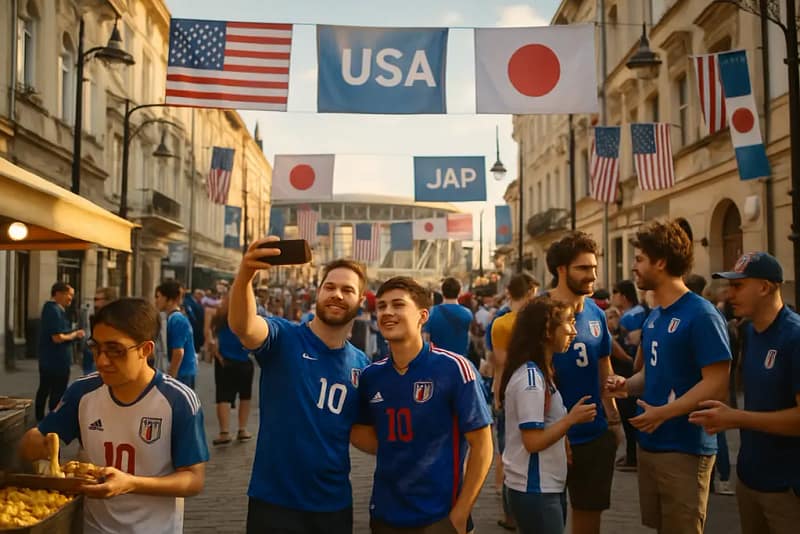

USA Japan U20 becomes the central Group D measurement point for the U.S. U-20 Women’s National Team on Wednesday, September 9, 2026, at Noon ET in Lodz, Poland. The match is the United States’ second group-stage fixture at the 2026 FIFA U-20 Women’s World Cup, which runs from September 5-27, 2026, with Group D also including Italy and New Zealand, according to U.S. Soccer tournament notes.
As of September 7, 2026, the most useful preview angle is not a predicted lineup or an assumed match script. It is the pressure created by Japan’s opening result, the United States’ roster profile, and the tactical contrast between a U.S. group that has shown scoring punch in preparation and a Japan side that has already taken three points in Poland.
Match Context In Lodz
USA Japan U20 Schedule Details
The fixture is placed in the middle of the U.S. group-stage path. The United States opened against Italy on Sunday, September 6, 2026, but the research supplied for this preview does not include that match result. The Japan match follows on September 9, and the U.S. closes group play against New Zealand on Saturday, September 12.
That sequencing matters. A second group match can either confirm a team’s control of its qualification route or force a more pressured final day. Japan entered the U.S. match week with an opening win, so the United States is preparing for an opponent that already has points on the board. The exact group table position depends on all completed Group D results, but the supported fact is clear: Japan beat New Zealand on September 6, while the U.S. schedule sends Vicky Jepson’s team into Japan before the New Zealand finale.
| Team | Supported Group D Context |
|---|---|
| United States | Second group match vs. Japan on September 9 at Noon ET in Lodz |
| Japan | Opened with a 2-1 win over New Zealand on September 6 |
| Italy | Listed in Group D and scheduled as the U.S. opener |
| New Zealand | Japan’s opening opponent and the U.S. final group opponent |
Why USA Japan U20 Tests Both Midfields
Transition Control Against Japan
The strongest tactical question is how the United States manages the spaces that appear after possession changes. Japan’s recent results point to a team comfortable in tight matches. A 2-1 tournament-opening win over New Zealand followed June 2026 friendlies in which Japan drew 2-2 with Canada and beat England 1-0, per the JFA schedule and results.
Those results do not give possession percentages, pass maps, or pressing data, so the preview should stay disciplined. What can be said is that Japan has already shown competitive balance across different match types: a narrow tournament win, a scoring draw, and a low-scoring friendly victory. That combination usually places a premium on midfield decision-making. If the U.S. gives the ball away while the team shape is stretched, Japan has enough recent scoring evidence to punish unsettled moments.
For the United States, transition play should not mean rushing every attack. It means choosing when to accelerate. Against an opponent that has recently managed close margins, the first forward pass after a recovery has to be cleaner than hopeful. The U.S. may need to use wide runners to stretch Japan’s back line, then reset if the direct lane is not available.
U.S. Roster Signals And Attacking Form
Linda Ullmark As A Reference Point
Vicky Jepson selected a 21-player U.S. roster made up of professional and college players. The age profile supplied in the research shows nine players born in 2006, seven born in 2007, and five born in 2008. That is a relevant development marker because the five youngest players are also age-eligible for the 2028 U-20 World Cup.
The most direct attacking note is Linda Ullmark’s production before the tournament. The research identifies her as the top U.S. U-20 scorer on the roster entering Poland, with six goals in seven U-20 caps. It also notes that the U.S. defeated the France U-23 WNT 5-0 in June 2026, with Ullmark scoring a hat trick. That result should not be treated as a guarantee against Japan, because friendly context and tournament pressure are different. Still, it is evidence that the U.S. arrived in Poland with a forward who had converted chances against older opposition.
For more U.S. player context tied to Poland, this site’s U.S. roster analysis tracks the same squad-building questions around scoring, defensive caps, and qualifying continuity. For cross-sport readers interested in expansive insights on youth development, a visit to BooksonBaseball offers additional resources.
The USA Japan U20 matchup should test whether the U.S. can turn that attacking form into repeatable chance creation. A single in-form scorer can tilt a match, but tournament opponents can plan around obvious threats. The supporting runners, second balls, and final-pass quality will matter as much as the first shot.
Japan Form And Defensive Profile

What The Recent Results Support
Japan’s official 2026 results give a cautious but useful profile. The 2-1 win over New Zealand on September 6 shows Japan began the World Cup with a result rather than just encouraging play. The June draw with Canada and win over England show Japan had faced different opposition styles before arriving in Poland.
The research describes Japan as possession-oriented and disciplined defensively. Without official match-level possession and defensive action data in the supplied source set, that should be treated as a qualitative note rather than a full statistical claim. Even so, the scores themselves show Japan has been capable of keeping matches within controlled margins. A 1-0 win over England is especially relevant from an analytical view because it points to a team that can protect a narrow advantage.
The U.S. cannot treat Japan’s opening win as a reason to sit back for long spells. If Japan has extended possession, the U.S. defensive block will need to stay connected between midfield and center back lines. If the U.S. presses, the timing has to be collective. One player jumping without cover behind can open the lane Japan wants.
Tactical Matchups That May Decide The Game
Width, Rest Defense, And Set-Piece Discipline
The tactical keys are straightforward because both teams have evidence of recent attacking competence. The U.S. has the June 5-0 win over France U-23 in its preparation profile. Japan has already scored twice in its World Cup opener. That does not mean the match will be open, but it does suggest that defensive concentration after turnovers is not a secondary detail.
- U.S. width: The United States needs wide occupation to prevent Japan from defending only the central lanes.
- Japan’s ball security: If Japan controls long possessions, the U.S. must avoid chasing in disconnected lines.
- U.S. transition timing: The first pass after a regain should create advantage, not hand possession back.
- Set-piece restraint: In a tight group match, fouls near the box and corner concessions can become the difference.
For the United States, patience is not passive. It means recognizing when Japan’s defensive shape is set and when it is momentarily unbalanced. For Japan, the risk is the opposite: too much comfort on the ball can invite a direct U.S. counter if a pass is underhit or a fullback is caught high.
This is where the USA Japan U20 game may be decided less by long spells of dominance than by short passages. A thirty-second sequence after a turnover, a second phase from a corner, or a delayed run from midfield could carry more weight than possession volume alone.
What USA Japan U20 Means For Group D
A USA Japan U20 win would keep Group D leadership firmly within reach for the United States, given Japan’s opening victory over New Zealand. A draw would still leave the final matchday relevant, while a loss would place heavier pressure on the September 12 game against New Zealand. Those are structural group-stage stakes, not predictions.
For the U.S. players, the match is also a high-value development test. Japan’s recent record in the supplied research gives the U.S. a demanding opponent: one that can win narrowly, score early enough to shape a match, and force opponents to solve possession and defensive spacing problems. Performances in that setting give coaches clearer evidence than lower-pressure friendlies.
For Japan, the match is a chance to pair its opening win with a second result against a major youth national-team program. The practical impact would be group control. The analytical impact would be confirmation that Japan’s preparation results carried into tournament play against varied opponents.
The most reliable expectation is a match shaped by midfield control, transition prevention, and finishing efficiency. The United States has supported attacking form in its preparation profile. Japan has supported tournament momentum after the 2-1 win over New Zealand. On September 9 in Lodz, the side that manages turnovers with more discipline should have the clearer route to a result.