
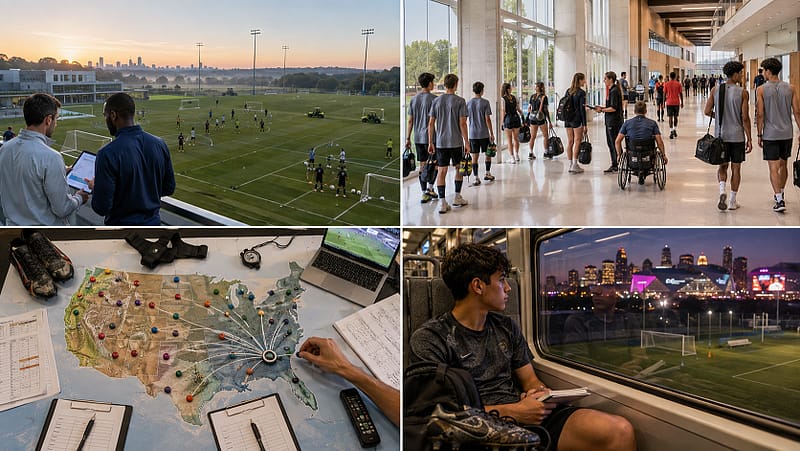

Atlanta’s role in the 2026 FIFA World Cup ended on July 15 with Lionel Messi and Argentina beating England 2-1 in a semifinal watched inside one of America’s most recognizable stadiums. Georgia’s role in American soccer, however, was only beginning. Less than an hour south of downtown Atlanta, U.S. Soccer now has something it never possessed before: a permanent national headquarters and training center built to connect senior national teams, youth development, coaching, sports science and extended forms of the game in one place.
That makes Georgia one of the most important states to watch in post-World Cup American soccer. The broader sports environment includes everything from MLS and NFL events to questions such as is sports betting legal in Georgia, but the state’s most significant long-term football investment is increasingly centered on development rather than entertainment. The Arthur M. Blank U.S. Soccer National Training Center in Fayette County gives the federation a permanent base at the exact moment the United States is trying to convert the visibility of a home World Cup into stronger players, coaches and national teams.
How Atlanta’s World Cup Summer Changed The Scale
Atlanta was not a minor stop during the 2026 World Cup.
FIFA scheduled eight matches at Atlanta Stadium, the tournament name used for Mercedes-Benz Stadium, including five group-stage games, a Round of 32 match, a Round of 16 match and the July 15 semifinal.

The last game in Atlanta carried enormous global weight. Argentina defeated England 2-1 to reach the World Cup final, with Messi and the defending champions providing the closing image of Atlanta’s tournament.
FIFA reported that more than 500,000 supporters attended Atlanta’s eight matches. For a city already accustomed to Atlanta United crowds, NFL games and major college football events, the World Cup demonstrated another level of international reach.
The lasting value is not that Atlanta proved it can fill a stadium. That was already known.
The more important development is that one of America’s leading soccer-event cities now sits beside the federation’s permanent football headquarters.
Why The National Training Center Changes The Geography
U.S. Soccer officially opened the Arthur M. Blank U.S. Soccer National Training Center on May 7 near Trilith in Fayette County.
The scale makes clear that this is not simply a headquarters building.
According to U.S. Soccer’s official opening announcement, the site covers 200 acres, with 123 acres currently developed. It includes 17 outdoor playing surfaces: 13 regulation-size natural-grass fields, two artificial-turf fields and two sand pitches for beach soccer.
There are more than 400,000 square feet of facilities, two indoor playing surfaces, a 10,000-square-foot performance gym, 20 locker rooms and 19 meeting rooms.
Most importantly, all 27 U.S. National Teams now have the same institutional home.
That changes American soccer because senior teams, youth teams, coaches, technical staff and sports-science specialists no longer have to operate entirely through temporary camps scattered around the country.
Georgia becomes the place where standards can be repeated.
Why September Shows What The Facility Was Really Built For
The most useful evidence of the training center’s value is not the ribbon-cutting ceremony. It is the calendar.
U.S. Soccer’s September schedule shows the Fayette County complex becoming a working national-team campus only months after opening.
The U.S. U-16 and U-15 Girls’ National Teams are holding concurrent camps there from September 1-8. The U-16 and U-15 Boys’ National Teams follow with their own programming. The U-17 Women’s National Team is scheduled to train from September 7-14 while preparing for qualification toward the 2027 FIFA U-17 Women’s World Cup.
The U-18 Men’s National Team is also scheduled for a September camp.
Extended national teams are using the same infrastructure. The Women’s Beach Soccer National Team, Men’s Beach Soccer National Team, Men’s CP National Team and Power Soccer National Team all have camps scheduled at the facility during September.
That diversity is one of the most important parts of U.S. Soccer’s September national-team calendar.
The facility is already operating as a soccer ecosystem rather than a senior-team compound.
How Georgia Connects To America’s Youth Development Problem
That youth emphasis matters because hosting the World Cup did not automatically solve the USMNT’s development challenge.
The United States exited its home tournament with a 4-1 Round of 16 loss to Belgium on July 6 in Seattle. The country proved it could host global football at enormous scale, but the senior national team still showed how much distance remains between American ambition and elite international performance.
The next step has to happen lower in the pyramid.
World Football Idol recently examined how the U.S. youth development pathway is expanding through MLS academies, USL environments, college soccer, European clubs and a larger national Talent ID network.
The Georgia facility gives those pathways somewhere to meet.
A prospect identified in California, Texas, Florida, New York or a smaller market can now enter a national-team environment built around shared performance standards. Coaches can compare players under consistent conditions. Sports-science data can be collected more systematically. Youth teams can work inside the same institutional framework as the senior USMNT and USWNT.
That does not guarantee better players.
It creates better infrastructure for evaluating and developing them.
Why Arthur Blank’s Investment Matters Beyond Atlanta United
Arthur Blank’s role connects several pieces of Georgia’s soccer growth.
Blank owns Atlanta United, which entered MLS in 2017 and quickly demonstrated that an American Southeast market could produce major soccer crowds. He also provided a $50 million lead gift toward the National Training Center.
The relationship between club growth, major-event infrastructure and federation investment gives Georgia an unusually connected soccer landscape.
Atlanta United creates a professional local reference point. Mercedes-Benz Stadium provides a proven international-event venue. The National Training Center adds federation infrastructure. Fayette County provides the physical campus where development can occur year-round.
U.S. Soccer President Cindy Parlow Cone described the facility as a place serving players, coaches, referees, members and fans rather than only elite senior teams.
That distinction is essential.
The strongest soccer nations do not operate only through 23-player World Cup rosters. They build coaching systems, youth pathways, technical education and institutional memory.
Georgia now hosts part of that process every day.
Why Accessibility Expands The Meaning Of A National Home
The training center also reflects a broader definition of American soccer.
Power soccer, beach soccer and futsal have dedicated playing areas. The complex was designed with wheelchair accessibility throughout, including lower lockers and benches, tactile and audiovisual elements and charging infrastructure for power soccer chairs.
The facility will host the men’s and women’s IFCPF World Cup from October 12-24, its first international tournament. Twenty CP football teams are expected to compete, including the largest women’s field ever assembled for an international CP football event.
That matters because a true national soccer home should represent more than one version of the sport.
U.S. Soccer is effectively putting senior international football, youth development, futsal, beach soccer and extended national teams on the same institutional map.
That is a different legacy from simply building another stadium.
Why Atlanta And Fayette County Now Serve Different Roles
Atlanta provides spectacle.
Fayette County provides repetition.
That distinction could become one of Georgia’s biggest advantages.
Mercedes-Benz Stadium can host a World Cup semifinal in front of tens of thousands of supporters. The National Training Center can host an U-15 player on an ordinary Tuesday morning years before that player becomes recognizable to the public.
American soccer needs both.
The 2026 World Cup proved that the United States has the stadiums, transportation networks, commercial scale and fan demand to host international football. The harder question is whether the country can build enough technical expertise and player depth to compete consistently with the countries filling those stadiums.
Georgia is now positioned on both sides of that challenge.
Why The Post-World Cup Legacy Is Already Visible
World Cup legacy is often discussed through projections: future participation, future investment, future facilities and future generations inspired by the tournament.
Georgia does not have to wait for all of that.
The infrastructure is already active.
The National Training Center opened before the World Cup. The USMNT trained there before beginning its tournament campaign. Youth teams followed. September is filled with development camps. Extended national teams are using the same grounds. An international CP football tournament arrives in October.
The World Cup then added another layer by bringing more than half a million spectators through Atlanta Stadium.
That combination makes Georgia increasingly difficult to treat as merely another American soccer market.
It is becoming an operational center.
The World Cup showed what Atlanta can look like when world football arrives. The Arthur M. Blank U.S. Soccer National Training Center shows what happens after the crowds leave.
For American soccer, the second part may eventually matter more.