
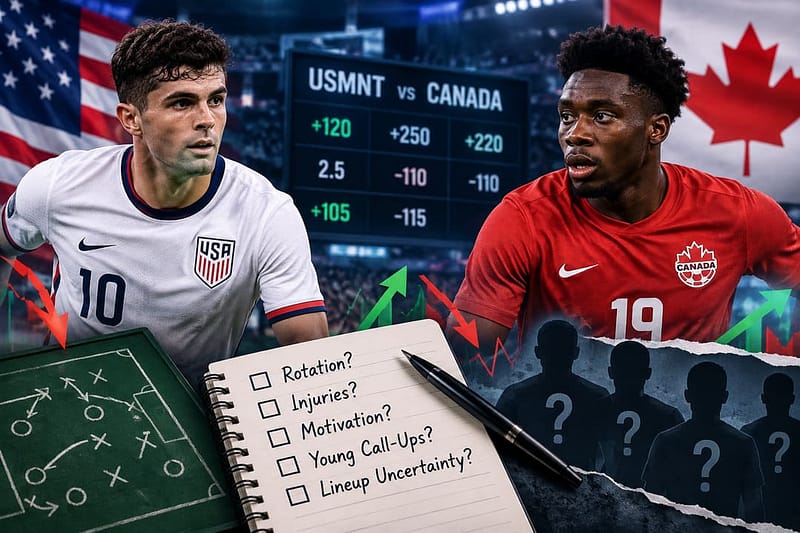

The United States’ October 6 meeting with Canada is an unusually good example of why international friendly betting requires a different type of analysis. The USMNT arrives at Allianz Field after beating Peru 4-1, Chile 4-2 and Mexico 3-0. Canada has opened its own fall window with a 1-0 victory over Chile and a 2-0 win against Peru. Those results suggest two teams in strong form. They do not, by themselves, tell bettors what either side will look like when the next starting XI is announced.
There is also a separate issue for American bettors before evaluating any price: whether regulated sports wagering is available where they live. U.S. rules differ by state, so a question such as is sports betting legal in Georgia concerns legal market access, not whether a particular USMNT or Canada price represents value. Georgia, for example, currently has no state-regulated sportsbook market. Keeping legality and football analysis separate prevents one issue from being mistaken for evidence about the other.
On the football side, the uncertainty is unusually visible. U.S. Soccer’s September-October roster release named a 28-player squad with 13 uncapped players and an average age of 22 years, nine months. The U.S. also scheduled four matches between September 26 and October 6 across Orlando, St. Louis, Glendale and St. Paul. That combination of youth, travel, experimentation and compressed scheduling creates a much less stable forecasting environment than bettors usually encounter in a domestic league.
The Scoreline Is Real, but the Signal Can Be Noisy
Recent form normally deserves considerable weight. A team consistently creating chances, defending well and winning matches is giving bettors useful information.
A friendly window complicates that logic because the team responsible for one result may look substantially different three days later.
Against Peru, 11 U.S. players earned their first senior international caps, including eight teenagers. Against Chile, Mauricio Pochettino fielded the youngest starting lineup of his USMNT tenure. Against Mexico, teenage forwards Julian Hall and Cavan Sullivan scored as the Americans won 3-0, while Diego Kochen made his full senior debut in goal.
That makes the three U.S. wins meaningful, but not in the same way three consecutive league victories with a settled first-choice XI would be meaningful.
The four-match USMNT friendly window is partly an evaluation exercise. A bettor therefore needs to separate team performance from lineup continuity. A convincing win can demonstrate that the player pool is deeper than expected without establishing that the same combinations, tactical roles or attacking relationships will appear in the next match.
Canada presents a related problem. Jesse Marsch selected Canada Soccer’s 26-player fall squad for matches against Chile, Peru and the United States. Canada won its first two games without conceding, yet Marsch also had a full international window in which to distribute minutes and evaluate combinations.
The mistake is not using recent form. It is assuming recent form came from a fixed team.
Friendly Motivation Is More Complicated Than “They Don’t Care”
Calling international friendlies meaningless is too simplistic, especially for USA-Canada.
Canada has won its previous two meetings with the United States, including a 2-1 victory in Kansas City in September 2024 and another 2-1 win in the 2024-25 Concacaf Nations League third-place match. Regional pride alone gives the matchup more edge than an ordinary exhibition.
But emotional intensity and competitive priorities are not the same thing.
For the United States, this window begins a new cycle under Pochettino toward 2030. U.S. Soccer explicitly described the squad as a mixture of experienced players and young prospects, while the site’s own analysis of Pochettino’s new-look USMNT roster shows how heavily the camp is tilted toward player identification.
That changes what a coach may consider a successful night.
In a qualifier, protecting a 1-0 lead and securing three points can dominate every other consideration. In a friendly, a coach may decide that testing a young center back, changing the midfield structure or giving a reserve forward 30 minutes produces more long-term value than preserving the strongest possible XI until the final whistle.
That does not mean a team wants to lose. It means winning is only one objective among several.
For bettors, that distinction matters most when assessing match-winner and handicap prices. A favorite can deserve its status based on overall talent while still carrying more substitution and rotation risk than its price initially suggests.
How Friendly Signals Differ From Competitive Matches
| Signal | What bettors may assume | Better friendly interpretation | Markets most exposed |
|---|---|---|---|
| Three straight wins | The strongest XI is in excellent form | Different lineups may have produced each result | Match winner, handicap |
| Major player absence | Entire team should be downgraded | Evaluate the missing role and replacement, not just the name | Totals, BTTS, player markets |
| Young starting XI | Inexperience automatically means weaker | Youth can increase energy and pressing while adding decision-making variance | Totals, match result |
| Regional rivalry | Both teams will prioritize the result above everything | Intensity can be high even while coaches experiment | Match winner, discipline markets |
| Late lineup surprise | Small adjustment to an existing forecast | It can invalidate an early betting thesis completely | Nearly every pre-match market |
The practical lesson is that a friendly price should be treated as a forecast built on less certain personnel assumptions.
That uncertainty deserves attention before any judgment about whether odds are attractive.
Rotation Risk Grows as the Window Gets Longer
The Canada game will be the United States’ fourth match in 11 calendar days.
That does not automatically mean the U.S. will field a weakened side. It does mean Pochettino has more reasons to consider minutes already played, training load, travel and opportunities for players who have not yet received the same exposure.
Canada, meanwhile, enters its third game of the window.
This difference is more useful than simply comparing which team has the better recent record. A player who started against Peru, Chile and Mexico is carrying a different workload from someone used primarily as a substitute. A teenager the staff wants to evaluate may receive minutes that would normally belong to an established veteran. A goalkeeper rotation can occur for evaluation rather than performance reasons.
Domestic-league models often benefit from relatively predictable selection patterns. Friendlies weaken that assumption.
That is why an opening price published well before a team sheet should not be interpreted with the same confidence as a price based on confirmed lineups.
Injuries Matter by Role, Not Reputation
Injury analysis becomes especially important when a roster is already experimental.
Ricardo Pepi was originally selected for the U.S. squad before withdrawing after suffering an injury with PSV Eindhoven, with Damion Downs added in his place. More broadly, WorldFootballIdol’s USMNT injury situation tracks how the absence of established players changed the context in which Pochettino was evaluating his squad.
But bettors should resist the automatic conclusion that every high-profile absence requires the same market adjustment.
Losing a primary creator can reduce the quality of final passes and force other attackers into unfamiliar roles. Losing a penalty-box striker may change crossing value, pressing responsibilities and the team’s ability to turn possession into high-quality shots. Losing a ball-winning midfielder can affect defensive transitions more than raw attacking production.
Those scenarios can point toward entirely different markets.
A forward absence might matter greatly for player props but only modestly for the match result if the replacement fits the system. A missing midfielder could matter more to both-teams-to-score or totals if the team’s ability to stop counters deteriorates. A fullback absence may change width, progression and defensive cover simultaneously.
The correct question is not “Who is missing?” It is “What tactical function disappears with him?”
There is another timing issue. If an absence has been known for several days, the market may already reflect it. Reacting to old injury news as though it has just appeared can lead a bettor to pay a price after the adjustment has already happened.
Young Call-Ups Make Historical Data Less Reliable
Head-to-head records are attractive because they look concrete.
USA and Canada have a long rivalry. Canada winning the previous two meetings deserves attention because it shows the matchup is no longer one in which American superiority can simply be assumed.
But historical meetings become less predictive when the personnel change dramatically.
The original U.S. fall roster contained 13 uncapped players with an average age of 19 years, six months. Eleven players then debuted against Peru alone.
At that point, a bettor is no longer comparing exactly the same USA-Canada relationship represented by older head-to-head numbers.
A teenager taking his first international minutes does not carry the same senior-team history as a veteran he replaced. A new goalkeeper changes the evidence available for evaluating defensive chemistry. A reorganized midfield can alter possession and transition patterns even though every historical database still labels the team simply as “USA.”
Historical statistics are still useful. They provide rivalry context, stylistic clues and evidence about how the programs have developed.
They should become background evidence rather than the centerpiece of the forecast when the actual players on the field have changed substantially.
Confirmed Lineups Can Be Worth More Than Opening Odds
There is always a trade-off between betting early and waiting.
An early bettor may find a better number before the market incorporates new information. The price of that opportunity is uncertainty.
Waiting for confirmed lineups can mean accepting a less attractive price after other bettors and sportsbooks have reacted. The benefit is that a major unknown has disappeared.
Friendlies push that trade-off further toward caution because lineup uncertainty is unusually high.
A bettor considering the United States because of its three convincing victories should ask whether the players responsible for those performances are actually starting again. Someone expecting Canada’s recent defensive record to continue should check whether the same defensive structure and personnel remain intact.
Line movement alone is not enough.
A shortening price can reflect team news, trading activity, liquidity or a combination of factors. The useful question is what new information arrived and whether it materially changes the probability of the outcome being considered.
If the entire case for a wager depends on a particular striker, midfield pairing or defensive unit starting, the bet does not really have a complete thesis until that lineup assumption is resolved.
What USMNT vs Canada Actually Teaches Bettors
USA-Canada is valuable as a betting case study precisely because there is no need to force it into a simple pick.
The United States has three consecutive wins in the window, but those performances have also featured mass debuts, extremely young lineups and significant experimentation. Canada has two straight clean-sheet victories and the confidence of winning the last two meetings with its neighbor, but it too is navigating a post-World Cup international window with its next competitive phase ahead.
The headline numbers are useful. They are simply incomplete.
For international friendly betting, the stronger process is to begin with recent form and team quality, then reduce confidence wherever roster uncertainty, workload, injuries or experimentation weaken the assumptions behind those numbers. Confirmed lineups deserve extra weight. Injuries should be evaluated by tactical role. Historical records should be discounted when the personnel producing them no longer resemble the team on the field.
That leads to a less exciting but much more useful principle: sometimes the biggest advantage a bettor can gain from a friendly is recognizing when the available information is not yet strong enough to justify a position.
USMNT vs Canada does not show that friendly odds are useless. It shows why the price only becomes meaningful when the football assumptions behind it are examined first.