
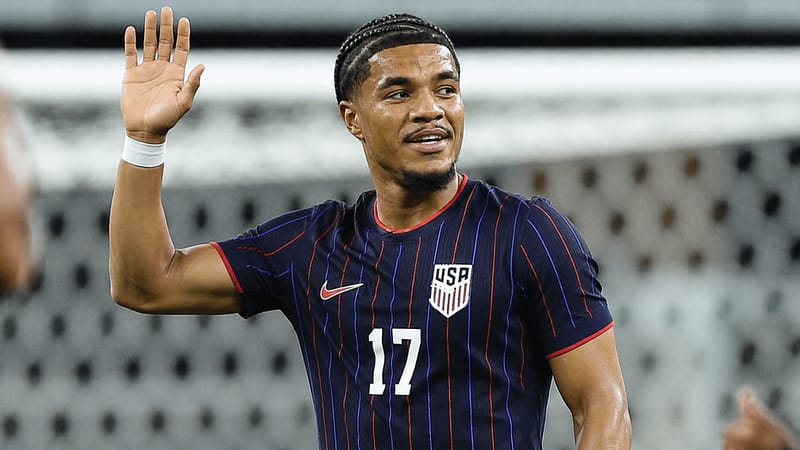

Malik Tillman’s free kick against Bosnia and Herzegovina did more than seal a 2-0 United States win in the Round of 32. It changed the shape of the USMNT conversation. For years, every major American tournament story has eventually bent back toward Christian Pulisic: his health, his burden, his form, his leadership, his ability to rescue the team. On July 1, 2026, at San Francisco Bay Area Stadium, Tillman gave the U.S. a different kind of World Cup image. With the team down to 10 men, tension rising, and a knockout match still alive, he stepped over a free kick in the 82nd minute and delivered the kind of moment that makes a national team feel deeper than one superstar.
Why Tillman’s Goal Changed The USMNT Conversation
The free kick itself was the clean headline. U.S. Soccer’s official match recap described Tillman’s strike as a direct free kick from about 20 yards on the left side of the penalty box, hit with pace by his right foot and parried into the net by Nikola Vasilj. It was the second U.S. goal in a 2-0 win, and it arrived after Folarin Balogun had been sent off in the 64th minute.

That timing is what gives the moment its weight. A goal at 2-0 in a friendly can be a highlight. A goal at 2-0 in a World Cup knockout match, with 10 men, becomes proof of nerve. The U.S. had already moved ahead through Balogun just before halftime. After the red card, the match could have turned into a defensive survival exercise. Tillman’s strike changed the emotional state of the game.
It was his first World Cup goal. It was the first direct free-kick goal by a U.S. player at the men’s World Cup since Eric Wynalda scored against Switzerland in 1994. It secured the USMNT’s first knockout-stage World Cup win since the 2002 victory over Mexico.
Those details matter for history. The bigger meaning sits in what the goal says about identity. The U.S. did not need Pulisic to score the defining goal. It did not need one familiar star to carry every attacking burden. It got a knockout moment from a quieter player whose value has grown inside Mauricio Pochettino’s system.
How Pulisic’s Return Still Fits The Larger Picture
Pulisic returned to the starting lineup against Bosnia and Herzegovina after playing only 77 minutes during the group stage due to a calf issue. That detail matters. This article is not about minimizing his importance. He remains the most recognizable player in the American pool, one of the team’s best chance creators, and the first name most opponents plan for.
The shift is about distribution of responsibility. A healthier USMNT identity does not remove Pulisic from the center of the picture. It makes sure the picture has more than one focal point.
Against Bosnia and Herzegovina, the scoring summary told that story. Balogun opened the match. Tillman finished it. Matt Freese made three saves and earned another clean sheet. Tim Ream, Tyler Adams, Weston McKennie, Antonee Robinson, Chris Richards, Sergiño Dest, and the rest of the defensive group managed the late pressure. Pulisic’s presence helped the attacking shape, but the match did not collapse into waiting for him to create something from nothing.
That balance is what Pochettino has been trying to build. World Football Idol’s recent breakdown of Pochettino’s World Cup plan focused on control, depth, and belief after the U.S. beat Australia. Tillman’s free kick took that idea into a higher-pressure setting. The U.S. plan held up in a knockout match with a man disadvantage.
That is a different USMNT story from past cycles.
Why Tillman’s Role Is Bigger Than One Set Piece
Tillman’s goal was spectacular, but his value against Bosnia and Herzegovina started earlier. U.S. Soccer’s scoring rundown credited him with the pass that led to Balogun’s first-half goal. That detail gives the night a fuller shape. Tillman did not just deliver the late strike. He helped connect the first one.
FOX Sports described the goal as Tillman’s biggest career moment and noted that he had helped set up Balogun before scoring the free kick himself. The same report described Tillman as a reserved personality whose play has started to answer questions about intensity, defensive commitment, and fit within a first-choice U.S. lineup.
That player profile is important. Tillman is not built like a loud emotional centerpiece. He can look calm to the point of quietness. In a World Cup knockout match, that calm became useful. He did not need the moment to look dramatic before the ball was struck. He needed the technique to be clean.
For the USMNT, this is the kind of development that changes squad psychology. A national team becomes harder to defend when opponents must respect second and third creators. If Tillman can receive between lines, combine with Pulisic, release Balogun or Ricardo Pepi, and threaten from set pieces, the U.S. attack becomes less predictable.
| USMNT Attacking Piece | What The Bosnia Match Showed | Why It Matters Going Forward |
|---|---|---|
| Christian Pulisic | Returned to the starting XI after limited group-stage minutes | Still draws defensive attention and shapes the attack |
| Malik Tillman | Assisted the first goal sequence and scored a direct free kick | Gives the U.S. another central creator and set-piece threat |
| Folarin Balogun | Scored his third goal of the tournament | Gives Pochettino a true World Cup No. 9 presence |
| Matt Freese And The Back Line | Protected a clean sheet after the red card | Lets the attack play with more trust in the structure |
How Balogun’s Scoring Form Supports The New Identity
Balogun’s goal against Bosnia and Herzegovina was his third of the tournament. U.S. Soccer noted that he became only the third American man to score three or more goals in one World Cup, joining Bert Patenaude in 1930 and Landon Donovan in 2010. That is not a small statistical footnote. It means the U.S. has a striker producing at a historic tournament rate.

For years, American tournament teams often relied on midfielders, wide attackers, set pieces, and chaos to find goals. A true center-forward run changes the math. Balogun’s movement forces opponents to defend the penalty area more honestly. That creates gaps for Pulisic, Tillman, McKennie, Robinson, and Dest to attack.
The red card against Bosnia created an immediate issue, and FIFA’s later disciplinary ruling around his availability for Belgium added another layer of debate. Yet the wider point remains: Balogun’s tournament has already shifted the USMNT’s attacking personality. He has made the U.S. look less dependent on one winger and more capable of producing goals through central-forward play.
That matters for Tillman too. A player like Tillman is more dangerous when there is a striker making clear runs ahead of him. His pass before Balogun’s goal and his free-kick finish showed two sides of that value. One came through connection. The other came through individual technique.
Together, those moments made the U.S. feel less like a team searching for one savior and more like a team with multiple routes to a goal.
Why Pochettino’s System Needs Shared Match-Winners
Pochettino’s most important World Cup job is not simply picking the best eleven names. It is building a team that can survive different match states. The Bosnia and Herzegovina win gave him almost every kind of test in one night: early control, a compact opponent, a halftime lead, a red card, late pressure, and the need for a second goal.
Tillman’s free kick helped solve the hardest part. The U.S. did not just hold on. It scored again.
That is a psychological distinction. Teams that only protect leads can begin to invite pressure. Teams that still carry a threat with 10 men make opponents hesitate. Tillman gave the U.S. that second category. He turned a nervous finish into a statement.
Pochettino now has evidence that the U.S. can win without every attacking action running through Pulisic. That does not mean Pulisic becomes less central. It means his teammates can reduce the defensive load placed on him. When opponents overcommit to Pulisic’s side, Tillman can appear between lines. When defenses drop off, Balogun or Pepi can attack the box. When foul trouble creates set pieces, Tillman gives the U.S. a high-level dead-ball option.
That kind of shared threat is what serious knockout teams need. The World Cup compresses games. Injuries happen. Suspensions happen. Stars get double-teamed. A team with only one solution eventually runs out of room. A team with four or five credible solutions forces opponents to make harder choices.
What This Means Before USA vs. Belgium
The next test is Belgium in Seattle on July 6. That matchup will pull the USMNT back into a familiar historical frame, especially after Belgium’s 2-1 extra-time win over the United States in the 2014 World Cup Round of 16. Tim Howard’s 16-save night still lives in American soccer memory. The 2026 version has a different question: can the U.S. create enough danger to avoid playing the role of brave underdog again?
Tillman’s form is central to that answer. Belgium will have to account for Pulisic. It will have to account for Balogun if he starts. It will have to respect the wide runs and delivery from Robinson and Dest. Tillman gives Pochettino a central player who can make Belgium defend a different channel.
That matters against a Belgian side that already survived drama in Seattle, rallying from two goals down to beat Senegal 3-2 after extra time. A team capable of that kind of comeback cannot be managed only by defending deep and hoping the clock moves quickly. The U.S. needs attacking pressure, midfield courage, and set-piece quality.
Tillman can contribute to all three. His presence between midfield and the forward line gives the U.S. a passing option. His defensive work must be sharp against Belgium’s midfield. His free-kick threat may change how aggressively defenders can foul near the box.
In a knockout match, one foul in the wrong zone can change a tournament. Tillman has already shown that.
Why This Moment Could Outlive The Highlight
Great World Cup goals can become isolated memories. Tillman’s free kick has a chance to become something more meaningful if it marks the moment the USMNT’s identity fully widened.
The Pulisic era has given American soccer a genuine global star. That matters. Yet the next step for the program is turning a star-led team into a threat-filled team. Tillman’s goal against Bosnia and Herzegovina showed that transition in one clean strike. Pulisic was on the field. Balogun had scored. The defense had absorbed pressure. The crowd was tense. Then Tillman delivered the knockout moment.
That is what mature tournament teams do. They do not ask the same player to solve every match. They let the match find the right player.
For the USMNT, Malik Tillman’s free kick was not just a beautiful goal. It was a sign that the team’s World Cup identity is no longer Pulisic-only. It is becoming shared, deeper, and more difficult to reduce to one name.