
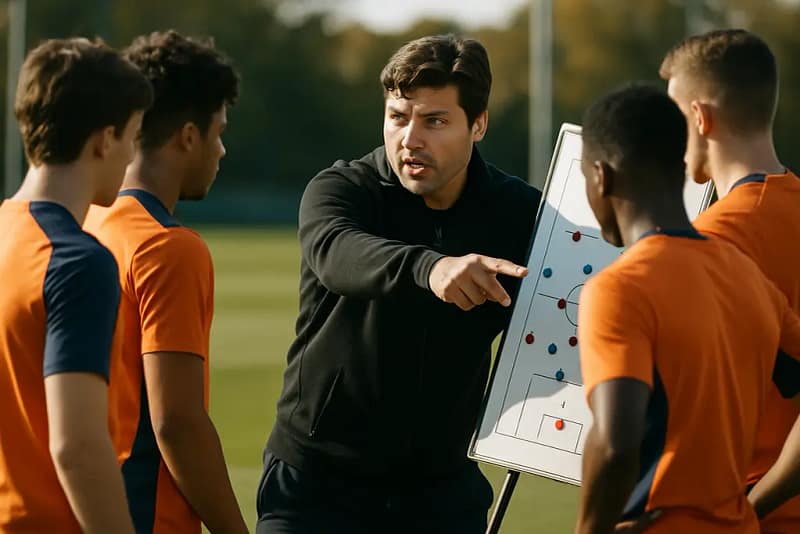

Pochettino USMNT vision became a longer-term U.S. Soccer project on August 3, 2026, when Mauricio Pochettino signed a new contract with the U.S. Soccer Federation through 2030. The agreement did more than extend the senior men’s national team head coach. It also gave Pochettino and his staff greater influence across the National Team pathway, including youth soccer, coaching education, collaboration with professional leagues, and other technical areas inside the federation structure, according to U.S. Soccer’s contract announcement.
That shift matters because the assignment is no longer limited to camp selection, match preparation, and senior-team results. Based on the federation’s own description, the plan now connects the USMNT, youth national teams, coach education, professional league relationships, and facilities into one technical direction. For a federation that has often had strong player pools but uneven age-group continuity, the significance is structural rather than rhetorical.
Pochettino USMNT Vision After The 2030 Contract
Why Pochettino USMNT Vision Now Extends Beyond Matchdays
The most direct reading of the contract is that U.S. Soccer wanted continuity after the 2026 World Cup cycle. Pochettino took charge in September 2024, and by mid-2026 his tenure had already involved 62 capped players from 16 leagues in 12 countries. That selection range is useful evidence of a staff testing a wide player base rather than treating the senior team as a fixed group.
The scoring distribution points in the same direction. Under Pochettino through mid-2026, 23 different players scored at least one of the 53 goals recorded by the USMNT. That does not prove a complete development model by itself, but it does show that attacking output was not concentrated in only one or two established starters. In roster terms, that matters because a national team with multiple scoring sources can absorb form changes and selection pressure better than a side dependent on a narrow core.
The 2026 World Cup provided a measurable senior-team reference point. The USMNT scored 11 goals, its highest scoring performance in a single World Cup, and defeated Bosnia & Herzegovina 2-0 in the knockout stage. That win ended the program’s wait for a knockout-stage victory since 2002. Those results help explain why the federation gave Pochettino a longer runway, but the next phase is less about repeating one tournament outcome and more about building a repeatable process.
What The Senior Roster Data Says
The most revealing number is not only the 11 World Cup goals. It is the use of 62 players across a broad club geography. A national team coach has limited training time compared with club managers, so the player pool must be monitored before camp starts. Pochettino’s work has included frequent contact with club coaches to track individual development and adjust individualized plans. That is a practical form of coaching development because it connects club environments with national-team expectations.
His stated selection principle, described as “no place is safe,” also changes the development incentives. If players know camp places are not guaranteed, performance at club level, fitness context, and tactical suitability remain active evaluation points. The research notes also show that Pochettino has considered special conditions such as injury and late preseason starts, which is relevant for players arriving from different leagues and calendar rhythms.
Coaching Development Inside The U.S. Soccer Pathway
Alignment From Youth Teams To The Senior Group
The central feature of Pochettino USMNT vision is pathway alignment. U.S. Soccer’s stated goal is to strengthen pathways for players, coaches, and teams across the federation so that the senior staff’s influence reaches youth and U-17/U-20 teams as well as the senior USMNT. That does not mean every age group should copy the senior team in a rigid way. It means terminology, evaluation standards, role profiles, and coaching expectations can become easier to transfer across age levels.
That type of alignment is particularly valuable for national-team football because player contact time is limited. A U-17 or U-20 player who understands similar pressing cues, positional demands, and off-ball responsibilities before reaching the senior group arrives with less adjustment cost. The same applies to coaches. If youth coaches are integrated into the same technical direction, the federation can create a clearer teaching model instead of relying on isolated age-group plans.
The caution is that alignment must not become uniformity for its own sake. Age-group teams need development space, and young players do not mature at the same pace. A strong pathway should clarify standards without narrowing the player pool too early. That balance is where coaching education becomes central.
Why Coaching Education Is The Long-Term Test
The contract extension gave Pochettino and his staff greater influence over coaching education, which may be the most durable part of the plan. Senior-team coaches can change match plans from camp to camp, but coach education can influence how players are taught years before they appear in a senior squad. If U.S. Soccer raises standards for youth coaches and connects them more closely with national-team ideas, the benefit could appear in better-prepared players rather than only in better-drilled teams.
That makes the project less dependent on one tournament. The 2026 World Cup already happened, and its returns were positive by several program markers. The next evaluation period runs through the 2030 World Cup cycle, with the 2028 Los Angeles Olympics also serving as an intermediate target. In July 2026, Steve Cherundolo was appointed U-23 men’s national team coach, and that team is viewed as part of the player pipeline toward both the Olympics and the senior team.
For readers interested in team composition across varied sports, the strategy is a familiar one: the effectiveness of developmental systems is frequently assessed by their ability to consistently provide depth. A similar analysis framework is employed in basketball at NBA Playbook, focusing on the significance of player development and roles in shaping team-building discussions.
Roster Competition And Player Development Standards
The Meaning Of “No Place Is Safe”
Pochettino’s “no place is safe” approach is not simply a motivational phrase. In national-team terms, it is a selection policy. It signals that established players must keep meeting performance standards, while new faces can enter camps if their form, fitness, and tactical fit justify it. That matters for a player pool spread across 16 leagues and 12 countries, because no single domestic or foreign competition can be treated as the only proving ground.
There is also a coaching benefit. If young players see a credible path into senior camps, youth-team environments become more competitive. If senior players know selection is active rather than inherited, camp intensity can improve. The risk is that constant churn can weaken cohesion, so the staff has to separate healthy competition from instability. The best evidence from the research is that Pochettino used a wide pool while still producing 53 goals through mid-2026 and an 11-goal World Cup output.
This is where Pochettino USMNT vision connects roster management with coach development. A staff that tracks players through club communication, adjusts individual plans, and keeps selection open needs a shared evaluation language. Without that, openness can become subjective. With it, competition can become a development tool.
Why Club-Coach Contact Matters
Pochettino’s frequent contact with club coaches is one of the more practical details in the research. National teams cannot control most of a player’s weekly workload, tactical role, or development environment. Club coaches do. Regular contact can help the national staff understand whether a player is changing position, returning from a special circumstance, adapting to a new league, or building match rhythm after a late preseason start.
That information supports better camp decisions. It also reduces the risk of judging players only from appearances or goals. For example, a player who does not score may still be meeting role-specific targets, while a player with strong output may need assessment against national-team tactical demands. The research does not provide individual names for these cases, so any player-specific claim would be inappropriate. The supported point is that Pochettino’s staff uses club communication as part of the development process.
Olympic Pipeline And The 2030 Cycle

The U-23 Team As A Bridge
The 2028 Los Angeles Olympics give U.S. Soccer a defined checkpoint before the 2030 World Cup. With Steve Cherundolo appointed in July 2026 to coach the U-23 men’s national team, that group can function as a bridge between youth development and senior-team selection. The value is not only the Olympic tournament itself. It is the chance to test players in a national-team environment with higher tactical and mental demands than most youth settings.
For the federation, the U-23 team can become a useful pressure point. Players close to senior level can be evaluated against age-eligible peers, while coaches can test whether the pathway standards are being absorbed. If the senior staff, U-23 staff, and youth coaches share clearer principles, player movement between squads should become easier to interpret.
An internal assessment of Pochettino’s contract extension also fits this discussion because the longer runway changes how U.S. Soccer can judge development markers across multiple age groups.
Facilities And Top-To-Bottom Alignment
The research notes identify facilities as part of the top-to-bottom alignment Pochettino has emphasized for the 2026-2030 cycle. That is a broad area, and the provided material does not list specific facility projects or spending plans. The safe analytical point is narrower: if the federation wants one technical direction across teams, the training environment, coaching access, and education structure need to support that direction.
Facilities do not develop players on their own. Coaches, competitive minutes, feedback, and tactical clarity still carry the main load. Yet facilities can support consistency by giving national-team staff better conditions for camps, coach interaction, and player monitoring. The research supports the importance of facilities in the plan, but not a detailed evaluation of individual sites.
Pochettino USMNT Vision For Coaching Development
The clearest reading of Pochettino USMNT vision is that U.S. Soccer has moved from a senior-team appointment to a federation-wide technical project. The evidence is specific: a contract through 2030, broader influence over the National Team pathway, attention to coaching education, integration with youth teams, contact with club coaches, and a U-23 Olympic bridge under Cherundolo.
The early senior-team indicators give the plan credibility without making it complete. The 2026 World Cup produced 11 USMNT goals and a 2-0 knockout win over Bosnia & Herzegovina, the program’s first knockout-stage victory since 2002. The broader player usage under Pochettino also showed an open selection model, with 62 players capped across 16 leagues in 12 countries through mid-2026.
The harder test is whether those senior-team gains become part of a repeatable development structure. By 2030, the fair questions will be whether youth coaches are better connected to senior-team standards, whether U-17, U-20, and U-23 players enter camps with clearer role understanding, whether coaching education has improved practical teaching, and whether roster competition continues without damaging continuity. Those are the evidence points that will decide whether the project becomes a lasting technical upgrade rather than only a successful contract extension.