
Royals Stadium Rezoning has become the key procedural issue in Kansas City’s downtown ballpark plan because the vote now sits between sports facility approval, Crown Center redevelopment, and the public-finance structure tied to the project. On September 3, 2026, a vote to rezone about 70 acres at Crown Center was delayed again while Kansas City finalized specialized tax increment financing districts connected to the project, KCTV5 reported.
The delay did not end the proposal. It did, however, keep binding land-use decisions behind finance details that city officials were still working through. For a Major League Baseball club trying to plan a new downtown venue, that distinction matters. Stadium projects depend on sequencing: zoning, district boundaries, infrastructure commitments, lease language, bond terms, and construction timing all have to line up before the sports side can move from concept to delivery.
Why Royals Stadium Rezoning Delays Matter
Royals Stadium Rezoning And The Council Clock
The September 3 postponement followed an earlier delay on August 11, 2026, when council committee members held ordinances rather than advancing them. That made the September delay more than a one-day scheduling issue. It showed that the council was still not ready to turn preliminary support into binding approval.
For urban development, Royals Stadium Rezoning is not only a stadium question. It is the land-use action that would help define what can be built, where associated development can sit, and how the Crown Center area could be organized around a ballpark district. When that vote moves back, related planning work becomes harder to treat as settled.
Why The TIF Sequence Matters
The city’s work on specialized TIF districts is central because tax districts are not decorative financing tools. They help define how public revenues may be captured or redirected for project-related costs. Until those districts are finalized, council members have less certainty about the public obligations attached to the rezoning vote.
That affects the development timetable in practical ways. Infrastructure planning has to be connected to real funding sources. District design has to match the land-use plan. Public review has to be able to evaluate both the stadium site and the surrounding mixed-use proposal. A delayed zoning vote leaves those pieces in a holding pattern.
Financing Pressure Around The Ballpark District
What The City Funding Framework Covered
Kansas City’s funding framework, approved on August 20, 2026, could provide up to $600 million for the project, including $90 million in direct infrastructure spending and $510 million in city-backed bonds. That level of public participation makes the rezoning delay more significant because land-use approval and public finance are being judged together.
That is why the project has drawn close review beyond baseball operations. A ballpark can shape game-day movement, nearby property planning, utilities, road work, and transit demand. A mixed-use district can extend those effects beyond 81 regular-season home dates. The city is not only considering where the Royals might play; it is weighing how a large district would fit into an existing urban area.
For readers tracking the public-risk side of the proposal, our related analysis of Kansas City’s $600M commitment breaks down the funding structure in a stadium-business context. For comparison with broader sports coverage across the same network, readers can visit My All Time Best to explore more on major venue and franchise stories.
Why Project Scale Changes The Review
The stadium itself has been estimated at $1.9 billion, and it sits within a broader $3 billion mixed-use redevelopment of Crown Center with Hallmark Cards, according to the Kansas City Star. That scale is why each delay carries weight. A project of that size touches more than a team venue. It connects to commercial space, district phasing, public infrastructure, and the long-term identity of a central Kansas City site.
The scale also explains why the council process has moved cautiously. Rezoning is a legal land-use step, but it is happening beside questions about bonds, tax credits, lease agreements, and public review. Each unresolved item can affect confidence in the others. If the public-finance map is unfinished, the land-use decision becomes harder to separate from funding risk.
Urban Planning Effects Around Crown Center
Land Use, Phasing And Development Certainty
Public documents filed on June 29, 2026, described a preliminary master plan covering roughly 91 acres and divided into 10 development subareas. The plan aimed to open the new stadium in time for the 2031 season, with full district build-out targeted by 2040. Those dates frame the planning challenge: the ballpark is the sports anchor, but the surrounding development is a long-cycle urban project.
A rezoning delay does not mean those targets have failed. It does mean that the approval path remained unsettled as of September 9, 2026. Developers, public agencies, and neighborhood stakeholders read delays differently depending on their role. A team may focus on stadium delivery. City staff may focus on district mechanics. Residents and nearby businesses may focus on traffic, displacement risk, and access.
Traffic, Access And Public Review
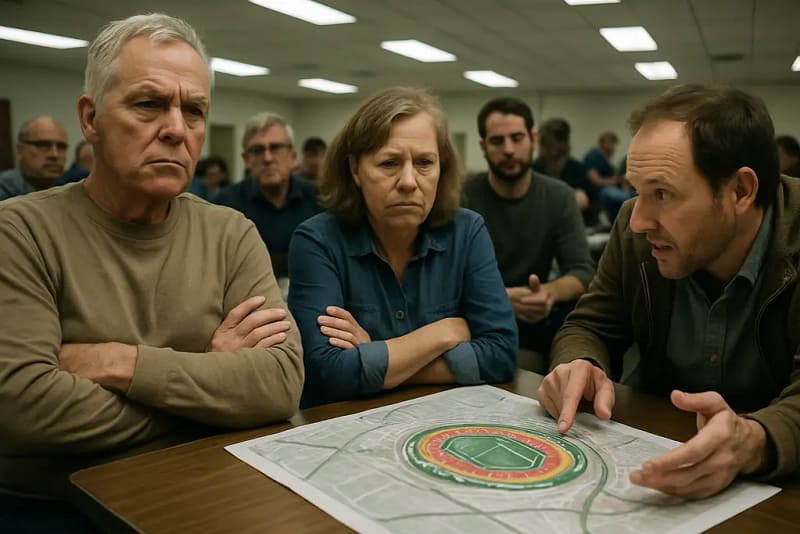
The July 28, 2026, community engagement meeting showed that the stadium conversation had already widened beyond baseball. Labor groups pointed to construction work and apprenticeship connections. Critics raised concerns about displacement, traffic, and the size of public subsidy. Those issues are typical for a downtown stadium district, but in this case they are tied directly to a vote that has not yet been completed.
For sports planners, access is not a secondary issue. A downtown ballpark has to manage weeknight arrivals, event overlap, service access, parking demand, pedestrian movement, and transit connections. The available research does not provide a final traffic plan, so the supported point is narrower: public concerns about movement and displacement were raised before binding council approval, and the rezoning delay preserved that review window.
Sports-Business Read On The Royals Timeline

Stadium Opening Target Versus District Build-Out
The Royals’ stated aim to open a new stadium for the 2031 season sits on a different clock from a full district build-out by 2040. That gap is common in large venue districts: the sports facility may need to open first, while surrounding development unfolds in phases. The delay matters because front-end approvals influence how much schedule cushion remains before design, financing, construction, and league-level planning have to be aligned.
From a team-performance standpoint, the venue issue does not change the Royals’ roster or on-field results by itself. Its impact is organizational. A stadium plan affects long-term revenue strategy, market positioning, fan access, premium seating, sponsor inventory, and game-day operations. Those are business elements that can shape a club’s future resources without producing an immediate box-score effect.
What Has Not Been Settled
Several major pieces were still not final as of September 9, 2026. The council had delayed binding rezoning action. Bond funding and lease agreements remained part of the broader approval picture. Opponents had sought a public vote on taxpayer spending, and legal arguments over state tax credits connected to the project were also part of the financing backdrop.
That means Royals Stadium Rezoning should be read as a checkpoint rather than as the whole stadium decision. Approval would not, by itself, complete the project. Continued delay does not, by itself, cancel it. The evidence supports a more limited finding: Kansas City’s development plan has been slowed at the point where land use and public finance meet.
Royals Stadium Rezoning And Kansas City’s Development Test
The immediate effect of Royals Stadium Rezoning delay is clarity, not construction, and Kansas City still lacked full clarity after the September 3 postponement. The city had a large downtown sports proposal, a major mixed-use redevelopment concept, a substantial public funding framework, and unresolved questions over finance tools and public review.
That mix makes the Crown Center proposal one of the more consequential venue-development stories in Major League Baseball. The Royals are not simply asking for a new ballpark location. The proposal ties a stadium to a large urban district, and that raises the standard for sequencing, documentation, and council accountability.
As of September 9, 2026, the supported reading is cautious: the delays have slowed the approval process, kept financing mechanics under review, and left urban development plans short of final authorization. The next meaningful movement will come only through dated public actions, not through assumptions about where the project is headed.