
USMNT development strategy is easier to assess after the September-October 2026 window because the team has moved from theory into match evidence. Mauricio Pochettino’s group has already played Peru on September 26, Chile on September 29, Mexico on October 3, and Canada on October 6. As of October 30, 2026, the next phase is more consequential: the Nations League quarterfinal home-and-away series against Haiti on November 14 and November 17, followed by a December 13 friendly against Jamaica in Fort Lauderdale.
The key distinction is not only opponent quality or match label. The fall friendlies were set up as evaluation fixtures, while the Haiti matches carry competitive consequences for the Nations League finals. That shift changes how roster experiments should be read. Pochettino can still test players, but official matches demand firmer role definition, clearer game-state management, and more disciplined squad selection.
USMNT development strategy after fall tests
Pochettino’s extended contract gives the current cycle a confirmed frame. U.S. Soccer announced that his deal runs through 2030, specifically tying the project to a wider four-year plan that includes the 2028 Olympics, 2029 Concacaf Nations League and Gold Cup, and the 2030 World Cup cycle through the Pochettino contract announcement. That matters because the November and December matches are not isolated dates. They are part of a longer roster-building period.
The Sept. 26-Oct. 6 friendlies against Peru, Chile, Mexico, and Canada were listed as part of the fall schedule, with AS also reporting that the 28-player September-October camp included 12 players who had not previously played for the USMNT senior team through the USMNT friendly schedule. That camp profile tells us the staff treated the window as a real player-pool audit rather than a narrow short-term selection exercise.
What USMNT development strategy measured
The most useful part of that fall window was the range of evaluation. Twelve uncapped players in a 28-player group created space to measure senior-team readiness, training adaptation, tactical retention, and match temperament. Julian Hall, Zavier Gozo, Neil Pierre, and Mathis Albert were among the young players identified in the research notes as part of that opportunity group.
The USMNT development strategy, in this context, was not only about minutes. It was about seeing which players could handle the rhythm around the senior team: pre-match preparation, travel, compressed camp instruction, and the pressure of wearing the shirt against varied opponents. Those factors are harder to evaluate at youth level or club level because international football compresses decision-making and reduces training time.
Veterans as roster stabilizers
The same camp also kept a veteran spine involved. Tyler Adams, Gio Reyna, Sergiño Dest, Chris Richards, Miles Robinson, Malik Tillman, and Yunus Musah were identified in the research as senior players expected to help guide younger teammates during the transition. That blend matters because a youth-heavy camp without experienced reference points can become difficult to read.
For a staff building toward several tournament checkpoints, the presence of those players gives the coaching group a cleaner comparison. A young player training beside Adams or Musah is being judged against the senior standard, not only against other prospects. That is valuable for selection clarity before official matches, especially with the Haiti series arriving in November 2026.
How the fall friendlies framed the player pool
The fall friendlies should be viewed as a screening layer. Friendly results have value, but the deeper use was to sort players into more specific development lanes. Some players can be pushed toward immediate senior depth. Others may remain better suited to Olympic-cycle work, U-20 exposure, or future camps.
That type of sorting is central to roster management because the senior team cannot carry every promising player at once. Pochettino’s staff has to determine who can help in Nations League settings, who needs lower-pressure minutes, and who benefits from age-group competition. A useful camp does not answer every question. It narrows the next set of questions.
Friendlies as controlled pressure
Peru, Chile, Mexico, and Canada offered different competitive profiles across a short period. The schedule required the staff to rotate, compare, and stress-test the squad. That is especially useful for uncapped players because it reduces the danger of overvaluing one isolated performance.
There is also a tactical value. A player who looks comfortable in one match context may struggle when the opponent presses differently, defends deeper, or creates more transition moments. The four-match block gave the staff more evidence for role fit, even if public evaluations should remain cautious without full internal data from training, GPS workload, and tactical meetings.
Why depth is not just a numbers issue
Depth is often discussed as a count of available players, but international depth is more specific. It means having players who can enter a camp quickly, understand the match plan, and perform without a long club-style adaptation period. That is why fall camps can be more meaningful than their friendly label suggests.
The roster discussion also connects to broader network analysis of player development across sports. For readers comparing squad-building ideas beyond soccer, the same network includes hockey roster coverage, where depth charts and player progression create parallel evaluation questions.
Within soccer, the more direct link is the post-fall assessment. A related roster review at USMNT roster strategy after fall friendlies fits this stage because the September-October camp created the evidence base for the November decisions.
Why the next fixtures carry different weight
The November matches against Haiti change the evaluation environment. The first leg is scheduled for November 14, 2026, at Sabina Park in Kingston, Jamaica. The second leg is scheduled for November 17, 2026, at TQL Stadium in Cincinnati, Ohio. Because these are Nations League quarterfinal matches, they count toward qualification for the Nations League finals.
That competitive layer limits how much experimentation the staff can reasonably carry into the starting XI. Pochettino can still use the squad to assess players, but official knockout-style football usually demands stronger continuity. The staff has to balance development with game management, especially over two legs.
Haiti ties move from trial to consequence
The Haiti series should show which lessons from the fall friendlies were retained. A player who impressed in September or October may now be asked to perform in a more structured context, with fewer loose minutes and less tolerance for positional errors. That is a different test.
For the coaching staff, the two-leg format also creates a tactical checkpoint. The first match can shape the second. Selection, substitution patterns, and set-piece choices must account for aggregate pressure. The staff cannot treat each match as a separate friendly-style exercise.
Jamaica friendly keeps evaluation open
The December 13, 2026, friendly against Jamaica at Inter Miami CF Stadium in Fort Lauderdale gives the staff another evaluation point after the Haiti series. Its placement matters. It comes after official Nations League matches, so it can be used to reassess players who were not central to the competitive tie or to revisit combinations that need more evidence.
That match should not be treated as disconnected from November. If the Haiti series clarifies which players are ready for pressure minutes, the Jamaica friendly can help define the next layer of depth. The staff can compare competitive-match choices against players who still need senior exposure.
Pipeline work beyond the senior roster
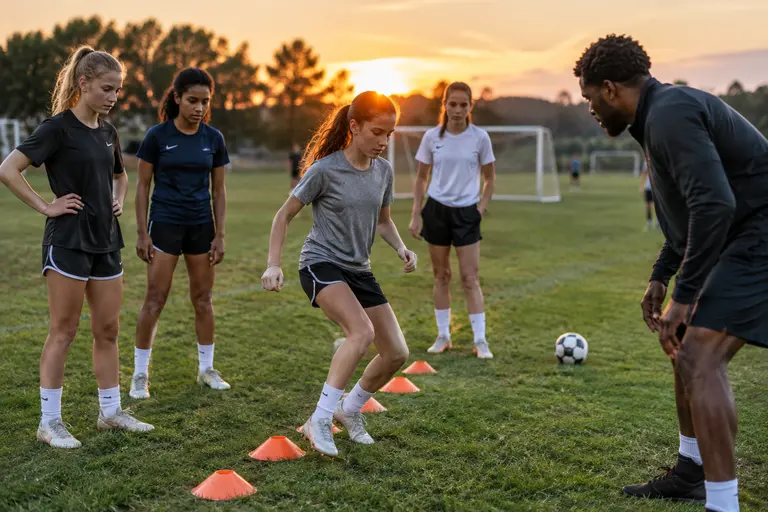
The senior matches are only one part of the cycle. The research notes state that Steve Cherundolo has been appointed to coach the U-23 men’s team, with that group preparing for the 2028 Olympic Games. That gives the program another channel for players who are not yet ready for full senior-team responsibility but still need high-level international development.
The U-19 men’s national team has also qualified for the 2027 FIFA U-20 World Cup, according to the research notes. That matters because the senior team’s long-term depth depends on more than one camp. It depends on repeated competitive exposure before players reach the full national team.
U-23 planning and youth progression
The Olympic track can help separate two different types of prospects. Some young players may already be senior-ready in specific roles. Others may need a tournament setting where they can carry more responsibility without being asked to solve senior-team problems too soon.
This is where Pochettino’s wider mandate becomes significant. A senior coach involved with youth pathways can align evaluation standards across age groups. That does not guarantee player development, but it creates a clearer path for coaches to compare performances from U-17, U-20, U-23, and senior environments.
USMNT development strategy against Haiti and Jamaica
The next matches are best read as a bridge between the experimental fall window and the larger 2030 project. The Haiti series forces selection decisions under competitive conditions. The Jamaica friendly then gives the staff another controlled setting to continue player assessment after those official matches.
The USMNT development strategy now depends on whether the staff can turn a wide September-October player pool into a more defined hierarchy. The evidence base is broader than it was before the fall friendlies, but the November and December fixtures will test whether that evidence leads to sharper role clarity, better depth decisions, and a steadier connection between youth development and senior-team needs.