
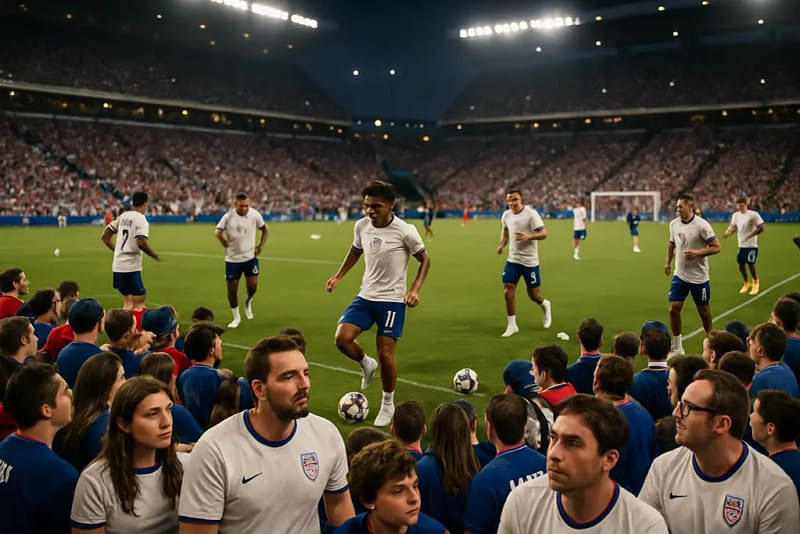

USMNT Friendlies are back on the immediate match calendar, and as of September 15, 2026, the next block is clearly defined: Peru on September 26, Chile on September 29, Mexico on October 3, and Canada on October 6, followed by Concacaf Nations League quarterfinal dates from November 9-17, according to NBC Sports’ USMNT schedule. The match list creates a compact window for evaluating form, roles, and availability without overstating what friendlies can prove.
From my live-update desk, the focus is not only on who starts. The sharper read will come from repeat usage, minute management, role clarity, and how the U.S. staff balances established names with players still competing for a more secure place. Friendlies can mislead if judged only by scoreline, but they are useful when viewed as evidence of tactical trust.
USMNT Friendlies Schedule And Match Rhythm
USMNT Friendlies Watch Point: Four Tests In Eleven Days
The spacing matters. Four matches in 11 days is not just a sequence of single-game evaluations; it is a stress test for squad rotation. Peru and Chile offer the first read on post-World Cup adjustments, while Mexico and Canada bring familiar Concacaf pressure and sharper rivalry conditions. The November Nations League quarterfinal window then adds a competitive marker after the friendly block.
That schedule makes player usage more telling than any one lineup. A player who starts twice, appears off the bench in another match, or is protected across short turnarounds may be showing where he sits in the staff’s hierarchy. A player who is held out of heavy minutes may not be out of favor; the context of recovery, travel, and workload will matter.
For those interested in a broader view on regional sports, ambikapurcity.com is a related site in the same network. Here, the focus on USMNT player evidence remains sharp, especially as they prepare for the September 26 opener against Peru.
Why Rotation Should Shape The Read
The confirmed schedule leaves little room for a fixed eleven across all four games. That makes some familiar questions more useful: who plays through midfield congestion, who can repeat high-intensity wingback actions, who leads the back line when the lineup changes, and which attackers keep chemistry even when the supporting cast rotates?
Our earlier September player watch framed the pool as a blend of veterans, MLS risers, and younger options. This window should sharpen that discussion because the opponents arrive quickly and the Nations League dates follow soon after.
Balogun, Pulisic And The Attacking Read
Balogun’s Scoring Evidence
Folarin Balogun enters this block with the clearest recent scoring marker among the attacking names in the research file. He scored twice in the United States’ 4-1 World Cup opener against Paraguay on June 12, 2026, a result reported by AP News on the Paraguay match. The research notes also list him at 12 goals in 31 U.S. appearances as of July 5, 2026.
For these USMNT Friendlies, Balogun’s evaluation should go beyond whether he scores. His pressing timing, near-post movement, link play with the attacking midfielders, and shot selection will all carry weight. A brace in a major tournament opener is strong evidence of finishing form, but friendlies can test whether that threat repeats when the match state is less open or the U.S. controls possession for longer spells.
Pulisic’s Creation Role
Christian Pulisic remains a central attacking reference point in the research notes, which state that he assisted in the opener against Paraguay and influenced first-half buildup. The same research file says his 2026 form before the World Cup had been limited in output, with two goal contributions before the pre-tournament friendlies against Senegal and Germany.
That creates a fair analytical split. Pulisic’s value cannot be reduced to goals and assists, especially if he is drawing defenders, receiving between lines, or starting combinations that lead to chances. Still, in this friendly block, end product will be part of the assessment because the U.S. needs clarity on which attacking partnerships can carry into the November Nations League quarterfinals.
- Balogun: watch penalty-box timing, hold-up choices, and whether his Paraguay finishing translates into repeat chance quality.
- Pulisic: watch first-touch direction, central combinations, and how often he creates separation in the final third.
- Gio Reyna: watch tempo control, final-pass timing, and whether his creative role is trusted against Mexico or Canada.
Midfield And Wingback Roles Under Review
McKennie’s Two-Way Baseline
Weston McKennie’s research profile gives the staff a known midfield reference. The notes list him at 71 caps, 12 goals, and seven assists for the national team as of mid-2026, and also state that he played every U.S. match in 2026 through the referenced data point, starting eight of nine. His only listed 2026 goal came in the March 28 friendly against Belgium, a 5-2 loss.
That history makes McKennie one of the more important control players in this block. In friendlies, midfield evaluation often turns on small details: second-ball recovery, late box arrivals, defensive covering angles, and whether the team can keep structure after turnovers. McKennie’s minutes across this window should tell us how heavily the staff still relies on his range and game-state adaptability.
Robinson’s Left-Side Value
Antonee Robinson is one of the more specific role fits in the research file. The notes say he returned from a knee injury and rejoined the U.S. squad in March 2026 for friendlies against Belgium and Portugal after being sidelined in 2025. They also describe his use as a left wingback in a 3-4-3 shape, with attacking involvement and defensive responsibilities.
That role is demanding. A left wingback must defend wide spaces, offer a passing outlet, join attacks at the right moment, and still recover when possession breaks down. The USMNT Friendlies against Peru and Chile may offer cleaner buildup sequences, while Mexico and Canada may test transition defending more directly. Robinson’s repeated sprints and crossing decisions should be monitored carefully, without making unsupported claims about fitness beyond the research notes.
Center-Back Leadership And Defensive Control
Richards As A Stability Marker
Chris Richards is listed in the research notes as fully fit ahead of the June 12 group-stage opener against Paraguay after recovering from injury. The notes also describe him as composed and defensively strong within a U.S. back line that was relatively young and less experienced during the World Cup.
In this upcoming window, his value should be judged by organization as much as individual defending. Center-backs in friendlies often face uneven rhythm because the midfield and fullback groups rotate. Richards’ communication, first pass under pressure, and ability to manage space behind the line will be important indicators if the staff uses different defensive partners across the four fixtures.
Ream’s Veteran Reference Point
Tim Ream gives the staff a different kind of reference. The research notes identify him as the oldest player on the U.S. roster during the 2026 World Cup and state that he appeared against Paraguay on June 12, becoming the oldest U.S. player to appear in a World Cup match. That is a specific historical marker, not a projection.
His role in these friendlies, if used, should be read through game management. Against Mexico or Canada, a veteran center-back can help settle spacing, talk younger defenders through pressure, and manage the tempo of possession. That does not guarantee a starting role or a fixed place in the Nations League plan, but it gives the staff a known option when the match needs calm decision-making.
What USMNT Friendlies Should Reveal
The most useful outcome from this window would be clearer evidence, not sweeping answers. Balogun can strengthen his case as the first-choice No. 9 if his movement and finishing stay sharp. Pulisic can reinforce his attacking role if chance creation and final-third efficiency rise together. McKennie can show whether his two-way midfield profile remains central. Robinson can confirm how valuable the left wingback role is to the team’s shape. Richards and Ream can give the defensive group different forms of control.
The Nations League quarterfinal dates in November make the September-October friendlies more than isolated tuneups. They are selection evidence before competitive matches return. The challenge for any live match update file will be separating real signals from friendly noise: repeated roles matter more than one highlight, workload patterns matter more than one start, and tactical fit matters more than reputation alone.
That is the frame to keep through Peru on September 26, Chile on September 29, Mexico on October 3, and Canada on October 6. The USMNT Friendlies should not be treated as final verdicts, but they can show which players the staff trusts when the calendar compresses and the next competitive checkpoint is already dated.