
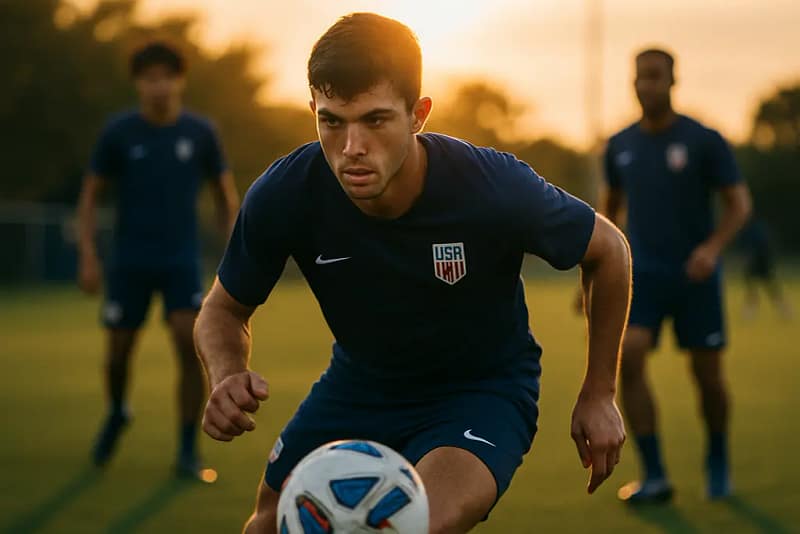

USMNT Roster Analysis begins with a clear tension in Mauricio Pochettino’s September-October 2026 selection: the United States is not treating the four-match window as a standard veteran tune-up, but it is not handing the group entirely to prospects either. On September 17, 2026, Pochettino named 28 players for matches against Peru on September 26 in Orlando, Chile on September 29 in St. Louis, Mexico on October 3 in Glendale, and Canada on October 6 in St. Paul, according to the U.S. Soccer roster release.
The structure of the roster is the most revealing part. U.S. Soccer listed 13 players from the 2026 World Cup squad and 13 uncapped senior internationals. That split gives Pochettino two evaluation tracks at once: established players who already understand senior international demands, and younger players who can be tested inside a more serious national-team environment before their roles become fixed.
USMNT Roster Analysis Starts With Balance
USMNT Roster Analysis By The Numbers
The age profile supports the idea that this camp is built for evaluation. The squad’s average age is 22 years and 9 months, more than four years younger than the 2026 World Cup roster. The 13 uncapped players average 19 years and 6 months, while the full group averages about 17 senior caps per player. That is not a normal veteran-heavy post-tournament squad, and it is not a youth camp detached from senior standards.
For a cautious USMNT Roster Analysis, the caps distribution matters more than the raw age number alone. A young squad can still be stable if its central players have repeated senior exposure. Here, Pochettino has kept enough experienced names to protect training quality while opening many roster spots for players who have not yet been tested at senior level. That approach reduces the risk of judging prospects in isolation.
The Four-Match Format Raises The Evaluation Value
The schedule also matters. Peru, Chile, Mexico and Canada give the staff four separate data points in different settings over an 11-day span. The matches are friendlies, but the opponents and travel pattern should allow Pochettino to compare how players respond to quick turnarounds, tactical changes and different emotional demands. Mexico and Canada carry Concacaf familiarity, while Peru and Chile give the group South American reference points.
This does not mean every uncapped player needs a major role in every match. A sensible staff can learn from training, late-game minutes, positional drills and how players absorb instructions. For young players, senior camp behavior is part of the evaluation. For returning veterans, the window can confirm whether their roles still fit the next version of the group.
Veteran Returns And Notable Absences
Caps, Returns And Senior-Team Stability
The veteran core is not absent from this roster. Tyler Adams, Sergiño Dest, Yunus Musah, Gio Reyna, Malik Tillman and Miles Robinson are included, giving the squad players with senior caps, club experience and prior exposure to pressure matches. U.S. Soccer identified Adams and Antonee Robinson as the cap leaders in the group with 58 each. Musah’s return is also relevant because his last senior national-team appearance came in March 2025.
Those inclusions give Pochettino a functional spine. Adams can help stabilize midfield standards. Dest and Robinson, based on their senior experience, can frame the fullback picture. Reyna and Tillman offer attacking-midfield reference points for younger creators. Miles Robinson gives a senior defensive presence. The value of that group is not only match performance; it is the training reference it creates for players trying to show they belong.
Absences Change The Evaluation Frame
Christian Pulisic, Weston McKennie and Folarin Balogun are among the 2026 World Cup veterans not included. The Guardian reported that Pulisic was omitted after a slow start at AC Milan, McKennie had dealt with muscle fatigue, and Balogun was struggling for playing time in its Guardian roster analysis.
The absence of those players changes how the attacking and midfield groups should be read. It does not automatically signal a long-term hierarchy change. It does, however, create a practical chance for other players to take on more responsibility in possession, pressing, chance creation and final-third decision-making. A separate USMNT injury report adds useful context on availability questions around this window.
This USMNT Roster Analysis should therefore separate opportunity from permanence. A player can benefit from a star’s absence without overtaking him. Pochettino’s task is to measure who can raise the floor of the squad, who can add a different profile, and who still needs more club minutes or youth-international development before becoming a regular senior option.
How The Youth Pipeline Shapes The Four-Match Window
U-20 And U-17 Links Are Clear
The youth pathway is highly visible in this call-up. Five uncapped players in the group — Cole Campbell, Zavier Gozo, Peyton Miller, Brooklyn Raines and Frankie Westfield — were part of the 2025 U-20 World Cup. Three others — Mathis Albert, Julian Hall and Cavan Sullivan — were part of the 2025 U-17 World Cup. That gives the roster a direct connection to recent youth-tournament cohorts rather than a random collection of club prospects.
That detail matters for development analysis. Players coming from youth World Cup environments have already handled some tournament preparation, international travel and age-group pressure. Senior football is a different standard, but the staff has at least some competitive reference points. It also suggests Pochettino and U.S. Soccer are not waiting for every prospect to become a full club regular before exposing him to the senior setup.
Cavan Sullivan Is The Headline Prospect
Cavan Sullivan is the youngest player in the roster at 16 and is set to turn 17 on September 28, 2026. The research notes that he has produced four goals and four assists across his last seven MLS games. That production explains why his inclusion has drawn attention, but the evaluation should stay grounded. A senior call-up at 16 is significant; it is not the same as a fixed role in a senior tournament lineup.
For Sullivan, the value of the window may be measured in training speed, decision-making under pressure and comfort around senior internationals. For the staff, it is a chance to see how his current MLS form translates when the physical and tactical demands rise. For the wider player pool, his call-up signals that age alone is not a barrier if performance and development markers justify a look.
MLS And Europe Give Pochettino Different Evaluation Points

MLS Players Add Domestic Form And Availability
Twelve of the 28 players are based in Major League Soccer, and nine of those are uncapped. The MLS-based uncapped group includes Philadelphia Union’s Neil Pierre and Frankie Westfield, Red Bull New York’s Adri Mehmeti and Julian Hall. That cluster gives Pochettino a direct view of domestic-league prospects who are already accessible to U.S. Soccer scouting networks and familiar to American player-development staffs.
The MLS group is especially relevant because many of the youngest players are developing in a league that continues to provide senior minutes earlier than many European environments. That does not make MLS minutes automatically superior. It does make them useful. A teenager playing meaningful professional football can show habits that are harder to evaluate only through academy or youth-national-team games.
European-Based Players Bring Continental Reference Points
The roster also includes 16 players based at European clubs. The research identifies several players connected to UEFA Champions League and UEFA Europa League environments, including Sergiño Dest, Mathis Albert, Alex Freeman, Tyler Adams, Yunus Musah, Malik Tillman and Auston Trusty. The September 20 roster adjustment involving Ricardo Pepi and Damion Downs should be treated as part of the window’s availability context, but the broader point remains: Pochettino is blending European exposure with MLS development paths.
That blend is useful for staff evaluation. European-based players may bring experience from higher-tempo club settings and continental competition preparation. MLS-based players may bring sharper current domestic form, stronger familiarity with North American conditions and, in several cases, more direct recent minutes. Neither category should be treated as a shortcut to selection. The question is how each player’s skill set fits the squad’s needs.
Readers interested in broader sports insights may find Banat Zayed valuable, but this article remains focused on the football strategies ahead of the September 26 opener.
What The September-October Roster Reveals
The clearest read from this window is that Pochettino is widening the player pool without removing its senior reference points. The 13 World Cup squad members give the camp credibility and continuity. The 13 uncapped players give it freshness and competitive pressure. The average age shows a genuine youth shift, while the inclusion of Adams, Robinson, Dest, Musah, Reyna, Tillman and Miles Robinson keeps the group from becoming purely developmental.
That is the most useful USMNT Roster Analysis takeaway: the September-October roster is less about naming a finished team and more about building comparison points. Who can handle senior training? Who can process tactical demands quickly? Who looks ready against Peru and Chile before the Mexico and Canada matches raise the Concacaf edge? Who benefits from the absence of Pulisic, McKennie and Balogun without needing that absence to define his long-term place?
The answers will not all arrive in one window. Still, the roster design is clear enough to evaluate now. Pochettino has combined returning senior players, MLS prospects, European-based talent and recent youth World Cup names into one test group. The strength of the plan is that it does not ask one generation to carry the full burden. It asks the experienced players to set the level and the new players to show whether they can reach it.