
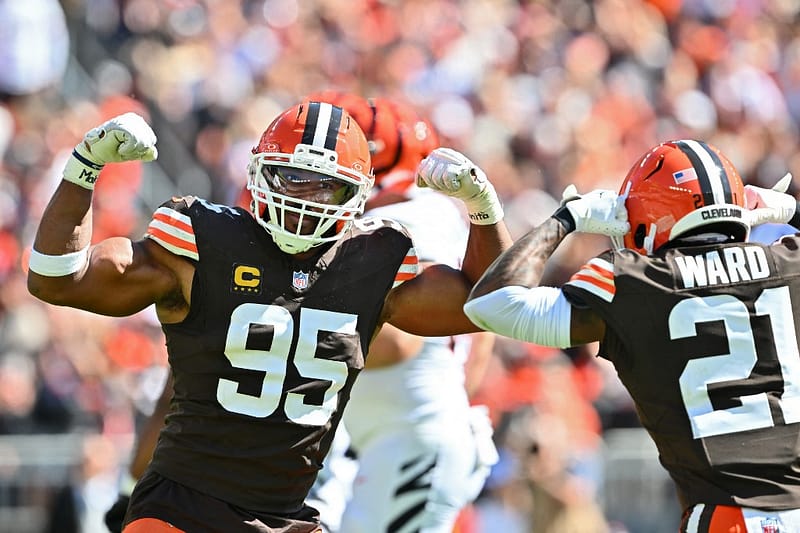

The Los Angeles Rams have never been shy about turning roster construction into a statement. When general manager Les Snead and head coach Sean McVay believe a championship window is open, they do not tiptoe around it. They attack it. The June 1 trade for Myles Garrett is the newest example, and it could make Rams training camp one of the most important NFL storylines of late July.
Garrett is not arriving in Los Angeles as a useful veteran addition. He is arriving as the reigning Defensive Player of the Year, a record-setting pass rusher, and the kind of defender who changes how opponents build protection plans before the ball is even snapped. That is why his first camp with the Rams could redefine what a Super Bowl favorite looks like in 2026.
For years, the phrase “Super Bowl favorite” has usually started with quarterback power. Patrick Mahomes. Josh Allen. Joe Burrow. Jalen Hurts. Matthew Stafford still gives Los Angeles that required veteran quarterback credibility, but the Rams’ newest version of contender logic is different. Their 2026 case begins with defensive gravity.
Why The Garrett Trade Changed The Rams’ Ceiling
The Rams did not need Garrett to become interesting. They were already positioned as a serious contender. CBS Sports described Los Angeles as a Super Bowl favorite before the trade and framed the move as an “All In 2.0” push for another championship at SoFi Stadium, built around the rare pairing of Garrett and Stafford. The price was massive: Cleveland received former Defensive Rookie of the Year Jared Verse, a 2027 first-round pick, a 2028 second-round pick, and a 2029 third-round pick in the blockbuster Myles Garrett trade.
That cost matters because it tells the league how Los Angeles views the present. This was not a cautious upgrade. It was a declaration that the Rams believe they can win now, while Stafford is still operating at an elite level and McVay remains one of the sport’s sharpest offensive coaches.
Garrett changes the ceiling because elite pass rush changes the math of every defensive call. A coordinator can pressure without blitzing. Corners can play more aggressively. Safeties can disguise longer. Interior linemen get cleaner one-on-ones. Opposing offenses must dedicate backs, tight ends, and slide protections toward one player, which creates openings elsewhere.
That is why this training camp is so important. The Rams are not simply installing Garrett into a normal defense. They are discovering how much of their defensive identity can orbit around him.
How Garrett Gives The Rams Defensive Gravity
Basketball analysts often talk about offensive gravity: the way one superstar pulls defenders out of position and creates opportunities for teammates. Garrett brings a football version of that idea. He draws attention even when he is not making the tackle. He affects cadence, protection calls, route timing, and quarterback pocket comfort.
CBS Sports made that exact point in its breakdown of how the Garrett trade changes the Rams’ defensive plan, comparing his effect to a superstar whose presence creates clean looks for others. That is the key to understanding Los Angeles’ 2026 vision.
Chris Shula does not need Garrett to record two sacks every week for the trade to matter. He needs Garrett to distort the offense. A rushed throw on third-and-7 matters. A running back staying in protection matters. A tight end delayed off the line matters. A quarterback moving off his first read matters. Those hidden wins can turn a good defense into a playoff defense.
World Football Idol’s earlier analysis of Myles Garrett’s sack record argued that elite defensive stars are changing modern NFL roster strategy. The Rams are now the clearest test case. They are betting that a defensive superstar can be as central to a championship plan as another premium offensive weapon.
Why Camp At Loyola Marymount Matters
The Rams’ 2026 training camp at Loyola Marymount University will run from July 27 through Aug. 6, with seven open practices for fans, according to the team’s official training camp announcement. That setting matters because Garrett’s arrival cannot remain a press-conference idea. It has to become a daily football reality.

Training camp is where Garrett learns Shula’s language, spacing, stunts, rush lanes, and adjustment calls. It is where the Rams decide how often he lines up wide, how frequently they move him inside, which down-and-distance packages maximize his burst, and how much they can pair him with other rushers without exposing the run defense.
It is also where the rest of the defense learns what playing with Garrett actually feels like. Defensive backs must understand that the ball may come out faster. Linebackers must be ready for rushed checkdowns. Interior linemen must anticipate different slide protections. Edge rushers opposite Garrett must be prepared to attack weaker protection looks.
The Rams’ camp is not only about whether Garrett looks dominant. That is expected. It is about whether everyone else looks more dangerous because he is there.
Why Trent McDuffie And Jaylen Watson Change The Formula
Garrett is the headline, but he is not the whole defensive rebuild. CBS Sports noted that adding Garrett alongside former Chiefs cornerbacks Trent McDuffie and Jaylen Watson signals a more aggressive Rams defensive style. That matters because pass rush and coverage are connected. A dominant edge rusher is more valuable when cornerbacks can challenge routes long enough for pressure to arrive.
McDuffie gives Los Angeles one of the league’s most versatile coverage players. Watson adds size, physicality, and tackling reliability. Together, they allow Shula to think differently. The Rams can press more often. They can disguise more. They can ask quarterbacks to hold the ball against tighter windows, knowing Garrett may not need much time to win.
This is where the Rams’ 2026 construction becomes fascinating. They are not building a defense around one old-school idea. They are building around synchronized aggression: pressure up front, coverage behind it, and a coaching staff willing to let stars create stress.
| Rams Defensive Piece | Main Value | Camp Question |
|---|---|---|
| Myles Garrett | Elite pass-rush gravity and protection distortion | How many ways can Chris Shula deploy him? |
| Trent McDuffie | Versatile coverage and tackling | Can he unlock more aggressive calls? |
| Jaylen Watson | Physical corner depth and perimeter support | How quickly does he settle into the secondary? |
| Chris Shula | Defensive structure and pressure design | Can he turn star power into weekly cohesion? |
| Matthew Stafford | Veteran offensive control | Can the offense protect leads created by defensive pressure? |
That table shows why the Rams are a different kind of favorite. Their profile is not only about scoring 30. It is about making opponents feel like every third down is shrinking.
How Stafford Fits Into A Defense-First Favorite
The Rams are not abandoning offense. Stafford remains central. Puka Nacua, Davante Adams, Kyren Williams, Sean McVay’s play design, and the offensive line still matter. But Garrett’s arrival changes the balance of the team’s identity.
A normal Stafford-McVay contender is expected to win through timing, route detail, explosive passing, and situational calm. This version of the Rams may be able to win differently. They can ask the offense to be efficient rather than perfect. They can play with field position. They can close games through pressure. They can punish opponents who become one-dimensional.
That matters in the playoffs. Championship games often become narrow. Weather, injuries, defensive adjustments, and opponent familiarity can shrink offensive margins. A team that can win with pressure has another path.
That is why Garrett’s camp is so important. If the defense becomes elite quickly, Stafford does not have to carry every postseason script. He can still win games with his arm, but the Rams’ championship argument becomes more complete.
Why Aaron Donald Speculation Shows The Size Of The Moment
The Garrett trade also reopened one of the most dramatic questions in Rams culture: could Aaron Donald ever return? CBS Los Angeles reported that McVay did not close the door on Donald possibly coming back, making clear that the decision would be Donald’s to make after speculation grew around the idea of him playing alongside Garrett.
The Rams cannot build their 2026 plan around a retired player’s possible return. But the speculation itself is revealing. Garrett’s arrival has made Los Angeles feel like a defensive destination again. It has stirred memories of the franchise’s last championship identity. It has reminded people that the Rams have a history of pairing star power with urgency.
Donald does not need to return for Garrett’s camp to matter. The point is that the trade changed the emotional temperature around the franchise. Los Angeles suddenly feels like the center of the NFL’s defensive imagination.
That is rare. Most Super Bowl favorites are discussed through quarterbacks, receivers, and offensive fireworks. The Rams are being discussed through pressure, disruption, and the possibility of building something terrifying up front.
Why This Is A Test For Chris Shula
Garrett’s arrival raises the ceiling, but it also raises the standard for Shula. A defense with this much investment cannot be ordinary. It cannot be talented but inconsistent. It cannot rely on Garrett to solve every passing down by himself.
Training camp will reveal how clear Shula’s plan is. Does Garrett move around the formation? Are McDuffie and Watson used aggressively? Do Byron Young, Kobie Turner, and the rest of the front benefit from cleaner opportunities? Are the Rams experimenting with pressure packages, or simply trusting Garrett to win isolated matchups?
The difference matters. Great players can elevate a system, but championship defenses still need structure. They need answers for quick passing. They need run fits. They need communication against motion. They need red-zone discipline. They need depth rotations that hold up over 17 games and through January.
Garrett makes Shula’s job easier in one way and harder in another. Easier because he gives the defense a superstar problem-solver. Harder because anything short of a top-tier unit will feel like wasted potential.
What Would Make Garrett’s Camp A Success
Garrett’s camp should not be judged by sack highlights alone. He is too good for that to be the standard. The better questions are more detailed.

Does the offensive line need extra help against him every day? Are other rushers winning because Garrett is drawing protection? Is Stafford’s practice rhythm being challenged in useful ways? Are the cornerbacks playing with more confidence because they trust the rush? Are younger defenders learning how to match Garrett’s urgency?
The Rams’ official newcomer update quoted Garrett saying he still has “plenty of great years” in front of him and that winning Defensive Player of the Year and a Super Bowl in Los Angeles is “pressing” on his mind through the team’s Myles Garrett newcomer profile. That urgency should shape camp. Garrett is not there to be celebrated. He is there to accelerate a championship timeline.
A successful camp would make that urgency contagious. If the defense practices like a group that knows its window is open, the Rams become more than a paper favorite. They become a team with a defined edge.
Why The NFC West Makes This Even More Interesting
The NFC West will not let the Rams ease into their new identity. The Seattle Seahawks are defending champions. The San Francisco 49ers remain a dangerous divisional rival with Kyle Shanahan’s offensive structure. The Arizona Cardinals are still trying to build toward relevance, but the division’s top tier is strong enough to test Los Angeles early.
That context matters because Garrett was not acquired for style points. He was acquired for games where one third-down pressure changes a drive, one strip-sack changes a quarter, and one hurried throw changes a playoff matchup.
If the Rams are going to separate from Seattle and San Francisco, they need their defense to travel. They need it to win in different game scripts. They need it to protect leads, rescue slow offensive starts, and pressure quarterbacks without constant blitz risk.
That is the kind of favorite the Rams are trying to become: not just explosive, but difficult. Not just popular, but uncomfortable. Not just loaded, but structurally dangerous.
What Garrett’s Rams Camp Could Redefine
Myles Garrett’s first Rams camp could redefine a Super Bowl favorite because it challenges the usual quarterback-first conversation. Stafford still matters. McVay still matters. Nacua and Adams still matter. But Los Angeles has pushed its championship argument toward defense in a way few modern favorites do.
The Rams are asking whether a team can be the league’s most compelling contender because its pass rush changes everything. Because its corners can play tighter. Because its coordinator can call more aggressively. Because opponents have to prepare for pressure before they prepare for the scoreboard.
That is a different kind of favorite. It is less about fantasy football shine and more about postseason stress. It is built around the idea that elite defense still scales when the games become smaller, louder, and more physical.
Garrett has already changed the Rams’ offseason. Training camp will show whether he changes their identity. If he does, Los Angeles may not just enter 2026 as a Super Bowl favorite. It may enter as the team redefining what a Super Bowl favorite can look like.