

The United States spent the summer of 2026 experiencing soccer at its biggest possible scale. World Cup stadiums filled, international supporters took over American cities, and the USMNT carried the pressure of trying to turn home-field advantage into a historic run. Now that the senior tournament has passed, one of the most important American soccer stories is happening much further down the player pathway.
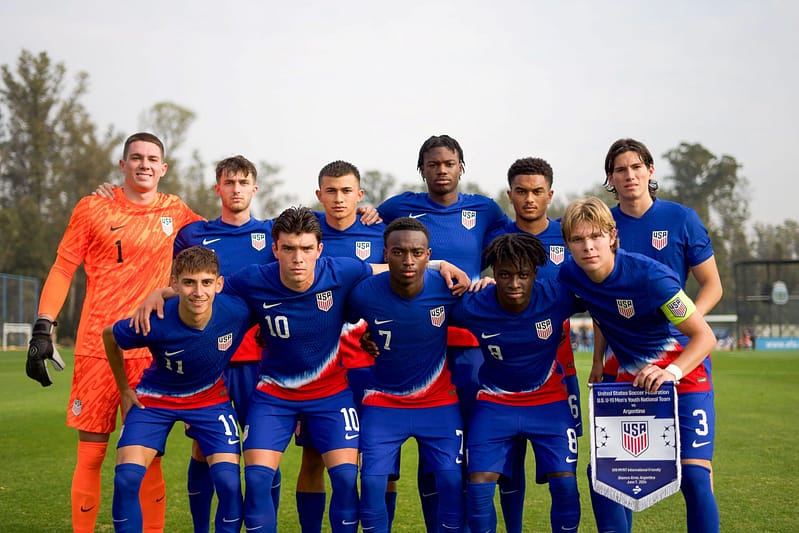
The U.S. Under-19 Men’s National Team has qualified for the 2027 FIFA U-20 World Cup in Azerbaijan and Uzbekistan after a strong run through the 2026 Concacaf U-20 Championship in Mexico. The age-group terminology can look unusual—the U.S. competed with its U-19 team in the confederation’s U-20 championship—but the competitive stakes were clear. Gonzalo Segares’ 21-player roster had to reach the semifinals to secure a World Cup berth.
It did much more than that.
The Americans won five matches, reached a fifth consecutive Concacaf U-20 final and showed why the next phase of the U.S. soccer conversation should increasingly focus on how young players are identified, developed and moved toward senior international football.
How The U.S. Turned Qualification Into A Statement
The Americans did not stumble toward qualification. They controlled Group A.
U.S. Soccer’s 2026 U-19 World Cup qualification recap shows a group stage in which the United States defeated Haiti 3-0, El Salvador 3-0 and Cuba 5-0.
That produced an 11-0 aggregate score across three matches.
Goalkeeper Kayne Rizvanovich recorded clean sheets throughout the group stage, while the attack spread responsibility across several players rather than depending on one obvious star. Dino Klapija, Rubén Ramos Jr., Santiago Morales, Christopher Cupps and others contributed during a phase in which the U.S. established itself as the tournament’s top overall seed.
That distribution matters for development.
Youth tournaments are useful precisely because they reveal whether a country is producing a handful of elite prospects or building larger groups capable of solving matches in different ways. The U.S. showed goals from forwards, defenders and set-piece situations while rotating players through meaningful minutes.
The quarterfinal then provided a different test.
Why The Guatemala Comeback Matters More Than The Score
The August 4 quarterfinal against Guatemala at Estadio Universitario BUAP in Puebla carried the biggest consequence of the tournament. Win, and the United States qualified for the 2027 FIFA U-20 World Cup and Pan American Games. Lose, and an unbeaten group stage would become irrelevant.
Guatemala scored first.
Oscar de León put Guatemala ahead in the 36th minute, giving the Americans their first conceded goal of the entire competition. For a young team that had controlled everything to that point, the moment created exactly the kind of developmental stress these tournaments are supposed to provide.
The response was impressive.
Brandon Dayes equalized in first-half stoppage time. Klapija put the United States ahead in the 68th minute, and Joshua Torquato finished the 3-1 comeback seven minutes later after a pass from Ramos.
Concacaf’s United States-Guatemala quarterfinal record recorded 64% possession for the Americans, five shots on goal and five big chances.
But the most useful development data was not statistical.
The United States fell behind in a qualification match and solved the problem.
Young players need those experiences before senior international football makes every mistake more expensive.
How Segares’ Roster Reflects A Changing American Pathway
The composition of the squad may be just as important as the results.
When Segares announced his 21-player U.S. roster, U.S. Soccer said 15 players represented 13 different MLS clubs. Two came from USL Championship teams, three were based with European clubs and one was playing collegiate soccer.
That is a useful snapshot of modern American player development.
The squad included FC Dallas players Jaidyn Contreras and Joshua Torquato, Inter Miami midfielders Santiago Morales and Alex Shaw, LA Galaxy forward Rubén Ramos Jr., Charlotte FC’s Nimfasha Berchimas and Orlando City’s Colin Guske.
It also included Klapija from RB Leipzig, Xanti Oyharçabal from Athletic Bilbao and goalkeeper William Lodmell from Sporting Lisbon.
Brandon Dayes represented Louisville City FC. Colton Swan came from Charleston Battery. Braden Dunham represented Furman University.
There is no longer one American route.
| Development Route | Examples From The 2026 U.S. Squad | What It Shows |
|---|---|---|
| MLS Academies And Clubs | FC Dallas, Inter Miami, LA Galaxy, Chicago Fire | Domestic professional pathways are central |
| USL | Louisville City, Charleston Battery | Second-tier professional environments matter |
| European Clubs | RB Leipzig, Athletic Bilbao, Sporting Lisbon | International development remains part of the pool |
| College Soccer | Furman University | The college route has not disappeared |
The American player pool is becoming a network rather than a pipeline.
That distinction matters.
Why U.S. Soccer’s New Talent ID Numbers Matter
Three days after U.S. Soccer published its recap of the U-19 tournament, the federation provided another piece of the development story.
Its August 14 report on how U.S. Soccer identifies youth talent described a system using regional managers across eight sectors of the United States, more than 200 part-time independent talent scouts and a network of nearly 500 talent reporters.
The scale is significant.
Between August 1, 2025 and July 31, 2026, U.S. Soccer said scouts received 6,515 assignments and observed approximately 2,220 players per week. Nearly 8,000 unique players were identified and tracked.
That process produced 1,276 unique Youth National Team camp call-ups, with 40% going to first-time participants.
U.S. Soccer also held 188 Talent ID Centers across 42 locations, including 12 goalkeeper-specific sessions that added more than 200 male and female goalkeepers to the player pool.
Those numbers provide context for the team that qualified in Mexico.
A youth national team is the visible end product. Thousands of scouting decisions happen before anyone reaches that roster.
Why Finding Players Is Now A Competitive Advantage
The United States has always had one obvious developmental advantage: population.
Turning population into elite soccer players is more complicated.
A huge country creates scouting problems. Talent can emerge in MLS academies, independent clubs, USL environments, college programs, immigrant communities and European systems. Geography makes identification difficult. Cost can limit access. Biological development happens at different rates. A teenager ignored at 15 may become an international prospect at 18.
That is why the federation’s emphasis on repeated monitoring matters.
U.S. Soccer says players can remain inside its scouting system for years before receiving a first Youth National Team invitation. Evaluation includes technical execution, physical execution, game understanding, responsibility, learning ability and growth mentality.
That is much healthier than treating early selection as a permanent ranking.
The development race is partly about finding the next star. It is also about reducing the number of potentially valuable players who disappear from view too early.
Why The Mexico Final Was Useful Even In Defeat
Qualification was achieved against Guatemala, but the tournament continued.
The United States defeated Costa Rica 2-0 in the August 7 semifinal at Estadio Banorte in Mexico City. Ramos scored in the 36th minute before Christopher Applewhite added the second in the 76th. The Americans held 79% possession and limited Costa Rica to two shots on goal.
That put the U.S. into its fifth consecutive Concacaf U-20 final.
Mexico was waiting.
In front of approximately 36,000 spectators, the final produced the kind of difficult lesson youth football needs. Mexico took the lead, Applewhite was sent off after a VAR review in the 45th minute, and the Americans had to play the second half with 10 men.
Cristóbal Alfaro scored twice as Mexico won 2-0.
The defeat should not be minimized. Rivalry finals matter, even at youth level.
But the result also should not erase the tournament.
The U.S. finished with five victories, a World Cup berth and only three goals conceded across the entire competition. It experienced dominant group matches, a comeback under qualification pressure, a controlled semifinal and then a hostile final against Mexico.
That is a much richer developmental sequence than six easy victories would have been.
Why The 2027 World Cup Is The Next Real Evaluation
Qualifying for a youth World Cup is not the finish line.
The 2027 FIFA U-20 World Cup in Azerbaijan and Uzbekistan will provide a much stronger test of how this generation compares internationally.
Players who looked comfortable against Concacaf opponents will face different tactical systems, physical profiles and technical standards. Some members of the 2026 qualifying roster will improve dramatically over the next year. Others may lose their place to players who develop later.
That turnover is normal.
The important question is whether the pathway keeps producing competition.
Segares now has tournament evidence on players such as Ramos, Klapija, Contreras, Torquato, Applewhite, Dayes, Rizvanovich and Shaw. The next year gives U.S. Soccer time to track those players alongside prospects who were not part of the qualifying squad.
That is exactly what an effective youth system should do: keep the door competitive.
How This Connects To The USMNT’s Post-2026 Problem
The 2026 World Cup exposed the central tension in American soccer.
The United States proved it can host football at enormous scale, but the senior national team still left the tournament after a 4-1 Round of 16 defeat to Belgium.
World Football Idol’s analysis of America’s post-World Cup soccer challenge argued that the country has already become an elite host while its national team still has work to do before becoming an elite World Cup contender.
Youth development connects those two realities.
Hosting infrastructure can create attention. Stadiums can create spectacle. Major tournaments can accelerate soccer culture. But none of those automatically create midfielders who solve pressure, defenders who handle elite attackers or forwards who finish World Cup chances.
Those players have to be developed.
That makes the post-2026 period especially important. American soccer has just experienced extraordinary visibility. The challenge now is converting some of that energy into stronger technical environments, broader scouting coverage and better pathways toward professional football.
Why MLS Academies Are Becoming More Important
Fifteen of the 21 players on Segares’ qualifying roster came from MLS organizations.
That does not mean MLS has solved American development. It does mean the league’s academy ecosystem has become deeply connected to the national-team pathway.
FC Dallas, LA Galaxy, Inter Miami, Atlanta United, Chicago Fire, Nashville SC, Columbus Crew, New England Revolution, Orlando City and other organizations were represented.
This creates a different American development structure from previous generations, when college soccer carried a much larger share of elite player preparation.
Professional clubs can expose teenagers to daily environments designed around first-team football. The best academy players can train upward, play in MLS NEXT Pro or move directly toward senior competition.
The U.S. still needs multiple routes. Its geography and population make one system impractical.
But the U-19 roster shows that professional academies are no longer peripheral. They are one of the central engines.
Why USL And College Soccer Still Matter
The presence of Dayes, Swan and Dunham also prevents the story from becoming too MLS-centric.
American development works best when different routes remain viable.
USL clubs can create professional minutes for young players who might otherwise be stuck behind older first-team players. College soccer can still provide development time, physical maturation and competitive opportunity for prospects whose timelines do not fit the academy-to-first-team model.
The objective should not be forcing every player through the same door.
It should be making sure enough doors lead somewhere useful.
That is particularly important in a country where player development is influenced by geography, family economics, education and access to professional clubs.
A national team that can pull players from Dallas, Florida, Southern California, Kentucky, Georgia, Europe and college soccer becomes harder to predict—and potentially harder to limit.
Why The Pathway Must Produce Senior Players
Youth success only matters if enough players eventually become senior professionals and senior internationals.
U.S. Soccer’s latest pathway report provides an encouraging connection: more than 90% of the players who competed for the U.S. men’s and women’s senior national teams last year previously participated with a Youth National Team.
That does not prove Youth National Teams create elite players by themselves. Clubs do most of the daily development work.
What it shows is that youth international soccer is an important bridge.
Players experience national-team coaching. They learn tournament travel. They face unfamiliar opponents. They discover how quickly international football punishes mistakes. They represent the country before senior selection carries the pressure of a World Cup qualifier or knockout game.
The U-19 team just received that experience in Mexico.
Next year it gets another level in Azerbaijan and Uzbekistan.
Why Youth Development Is America’s Next Soccer Story
American soccer does not need another debate about whether one talented generation will finally change everything.
The more useful question is whether the system can repeatedly produce strong generations.
The 2026 U-19 team offers evidence worth following. It won its group 11-0. It recovered after conceding first against Guatemala. It qualified for the World Cup. It reached another regional final. Its roster drew players from MLS, USL, Europe and college soccer.
Behind that team sits a scouting network that tracked nearly 8,000 players in a year.
That is the story.
The United States already knows it can stage the biggest soccer tournament on Earth. The 2026 World Cup settled that question.
The next challenge is more difficult and more important: building enough technically sophisticated, tactically intelligent and internationally tested players that American national teams can consistently match the scale of the country’s soccer ambitions.
The U-19 World Cup berth does not prove that process is complete.
It shows where the next phase begins.