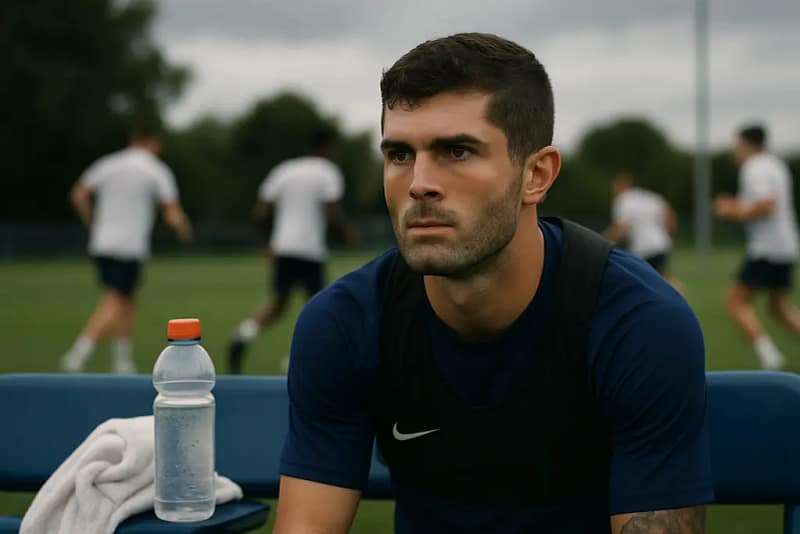

The USMNT Injury Report for September 17, 2026, centers on availability rather than alarm. Christian Pulisic and Yunus Musah are the two clearest health-related absences ahead of the September-October friendly window, while several other World Cup roster names were omitted for reasons that should be treated as roster decisions unless a medical reason has been clearly reported.
Mauricio Pochettino’s group is scheduled to play Peru on September 26 in Orlando, Chile on September 29 in St. Louis, Mexico on October 3 in Glendale, and Canada on October 6 in St. Paul. That four-match stretch gives the staff a short, useful sample across different opponent types, but it also reduces the margin for half-fit players. The selection tells us the staff is not forcing every established name back into the group before the player’s club rhythm and medical progression are fully aligned.
Pulisic And Musah Drive The Health Picture
Why The USMNT Injury Report Starts With Pulisic
Pulisic’s case is the central fitness story because of both his role and the timing. FOX Sports reported that he suffered a bone bruise and microfracture of the tibia and fibula in his right leg during the United States’ World Cup Round of 16 match against Belgium on July 6, 2026, and that he was left off the September-October U.S. roster while his recovery remained incomplete FOX Sports roster report.
That detail matters tactically. Pulisic is not just a winger in name; for the U.S., he has often been the player who turns possession into territory, draws defensive attention, and gives the team a direct ball-carrying outlet. Without him, the staff loses a high-usage attacker and must redistribute chance creation across other wide players, attacking midfielders, and fullbacks. That is not automatically negative in a friendly window, but it changes the evaluation lens. The staff can assess structure without leaning on one established attacker to solve progression problems.
For this USMNT Injury Report, the cautious reading is simple: availability from the bench at club level is not the same as being ready for a multi-city international window. Pulisic had returned to group training with AC Milan on August 21, 2026, according to the research notes, and had been available for selection in early September, but he had not logged Milan minutes in the club’s first three Serie A matches by early September. That gap between medical availability and competitive sharpness is meaningful for national-team planning.
Musah’s Groin Injury Narrows Midfield Options
Yunus Musah’s left groin injury, sustained during club duty in mid-September 2026, creates a different roster problem. The research notes state that he was ruled out of the upcoming September-October friendlies and that Johnny Cardoso was called in to replace him. Unlike Pulisic, Musah’s value is less about end-product and more about ball security, pressure resistance, and carrying through midfield traffic.
His absence reduces the number of proven midfield profiles who can receive under pressure and help the U.S. play through compact central areas. Cardoso’s call-in gives the staff another central option, but the change should not be framed as a one-for-one tactical copy. Musah’s athletic ball progression and ability to cover ground are specific traits. Without him, the staff may place more weight on positional discipline, spacing, and the timing of midfield rotations.
USMNT Injury Report And Roster Context
Pochettino’s September Group Includes A Youth Marker
The Washington Post reported that Cavan Sullivan, age 16, was included in Pochettino’s September-October U.S. roster and could become the youngest U.S. men’s national team player since Freddy Adu if he appears against Peru on September 26, 2026; the same report listed the four friendly dates and sites for the window Washington Post roster details.
Sullivan’s selection should be separated from the injury discussion, even if Pulisic’s absence creates more attention around attacking roles. A young player’s inclusion does not prove a direct replacement plan. It does, however, give the staff an evaluation opportunity during a window in which at least one top attacking option is unavailable. That balance is sensible for friendlies: protect the recovery of an established player while collecting live information on a younger option.
The USMNT Injury Report is not a full explanation of the roster. Matt Turner, Antonee Robinson, Tim Weah, and Brenden Aaronson were also omitted, according to the research notes, but those absences should be labeled carefully. Unless a source clearly identifies a current injury reason for a given player, the safer analysis is that those are selection or roster-cycle decisions, not medical updates.
What Dest’s Return Adds To The Availability Picture
Sergiño Dest’s status belongs in the broader availability discussion because the research notes state that he has returned from a serious ACL injury earlier in the cycle and resumed full participation with PSV Eindhoven. His inclusion in selection talks reflects a different stage of the injury arc: not initial absence, but the process of re-entering national-team calculations after a long layoff.
For roster evaluation, Dest’s case is a reminder that injury reports are not only about who is unavailable. They also track who is rebuilding trust through repeated club participation. The staff still has to weigh workload, match rhythm, and tactical fit, but full participation at club level is a relevant step for any player returning from a major knee injury.
How Absences Change The September Fixtures
Four Matches Create A Workload Test
The schedule is compressed enough to matter. Peru on September 26, Chile on September 29, Mexico on October 3, and Canada on October 6 create four match opportunities in eleven days. That format can help a staff compare players under different conditions, but it also makes careful workload management necessary for players coming off recent injuries or interrupted club starts.
| Player | Status From Research | Roster Impact |
|---|---|---|
| Christian Pulisic | Recovering from right-leg bone bruise and microfracture | Removed a leading wide attacking option |
| Yunus Musah | Ruled out with left groin injury | Reduced central midfield ball-carrying depth |
| Sergiño Dest | Back in full PSV participation after ACL injury earlier in cycle | Relevant to right-back and possession structure evaluation |
| Cavan Sullivan | Called up at age 16 | Gives staff a youth evaluation point |
Without Pulisic, the U.S. may need more collective chance creation from midfield and wide combinations. Without Musah, the midfield may need clearer passing angles and better spacing to replace his ability to carry through pressure. Those are not predictions about the lineup. They are the logical roster effects of removing two players with distinct ball-progression roles.
For readers exploring the wider sports network, Back2Tap provides insightful pieces that focus on player status as an element of team strategy rather than mere speculation. The same principle applies here: the medical facts matter most, and the tactical interpretation should stay within what the reporting supports.
Player Availability Notes Beyond The Injury List
Selection Absence Is Not Always Injury Absence
The cleanest injury analysis avoids blending different categories. Pulisic and Musah have specific health updates in the research. Dest has a return-from-injury context. Turner, Robinson, Weah, and Aaronson are roster omissions in the supplied notes, but the available source set does not provide the same current injury detail for each of them. That distinction protects the analysis from overstating the medical side of the story.
This matters for evaluating Pochettino’s approach. If a player is injured, the question is recovery and risk. If a player is omitted by selection, the question is role, form, tactical fit, or cycle management. Those are different evaluations. Blurring them can create a misleading depth-chart picture, especially before friendly matches designed partly for testing.
For a related roster lens, our earlier USMNT September friendlies watch focused on the player groups likely to draw attention during this window. That context fits with the current availability picture because absences often create evaluation minutes for less established names.
Why Club Rhythm Matters Before International Minutes
The gap between training, bench availability, and match fitness is central to Pulisic’s case. A player can return to group work and still lack competitive rhythm. A player can be named to a club matchday squad and still not be ready for a demanding national-team window with travel, training, and multiple opponents. That is especially true after a bone-related leg issue, where the research notes describe a rest and re-athletization timeline rather than an instant return.
The USMNT Injury Report therefore points less toward crisis and more toward sequencing. The national team gains little by treating incomplete recovery as full readiness in a friendly window. The staff can use the matches to test alternatives while Pulisic continues his club-based progression.
What The USMNT Injury Report Means For Pochettino
Pochettino’s task in this window is to separate short-term absences from longer-term roster information. Pulisic’s absence removes a first-choice attacking reference point. Musah’s injury narrows midfield options. Dest’s return path adds a fullback storyline. Sullivan’s call-up gives the staff a youth evaluation point during a window that is already reshaped by availability.
The analytical value of these friendlies is not reduced by the absences; it is changed. The staff can learn how the team builds attacks without Pulisic, how the midfield handles pressure without Musah, and which players can handle larger roles across a tight four-match run. That does not make the absences minor. It means the staff has to treat them as part of the evaluation design.
The most responsible reading of the USMNT Injury Report on September 17, 2026, is that two key players are unavailable for clear health reasons, one returning fullback remains relevant to selection talks, and several other omissions should be discussed as roster decisions unless stronger medical reporting emerges. For a friendly window, that is enough to reshape roles without requiring unsupported claims about recovery speed, lineup guarantees, or long-term status.