
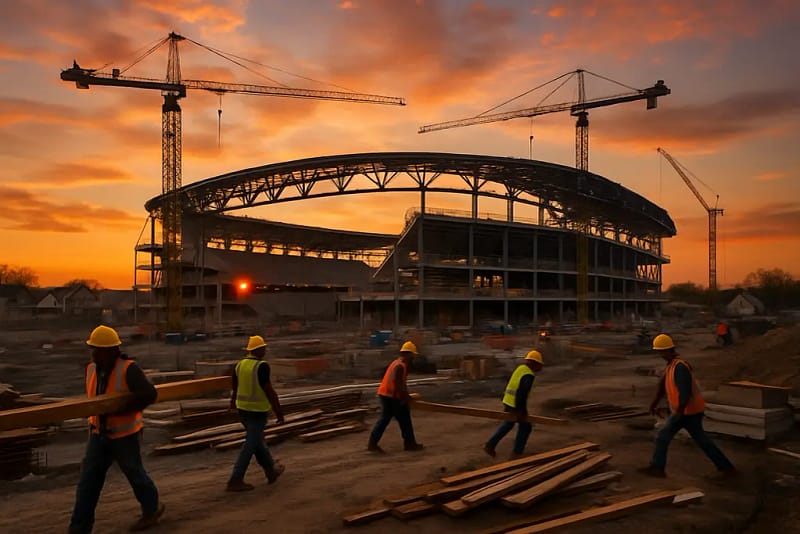

The Indianapolis MLS stadium discussion has moved from a single-site development pitch into a broader test of how a soccer venue district would affect public finance, downtown growth, affordability, and long-term trust in local sports investment. As of September 21, 2026, no MLS expansion slot had been awarded to Indianapolis, and the strongest supported reading is still conditional: the city has a finance framework, a stadium-district concept, and continuing league interest, but not a completed franchise launch.
That distinction matters for any sports analysis. A stadium district can shape matchday logistics, club identity, roster investment capacity, and supporter culture, but those effects depend on whether the project reaches the league approval, ownership, site-control, and funding milestones that still sit between concept and kickoff. The community side is just as sensitive. A downtown soccer district can concentrate activity around a venue, but it can also increase cost pressure in neighborhoods already dealing with affordability concerns.
Indianapolis MLS Stadium Revenue Case
What The PSDA Numbers Support
The strongest financial case for the project comes from the Professional Sports Development Area, or PSDA, proposal tied to a new MLS/NWSL stadium concept. A Hunden Partners analysis submitted on August 6, 2024 projected that a PSDA connected to a new soccer stadium could generate approximately $2.1 billion in state and local tax revenue over a 32-year period from 2025 through 2056, with roughly $1.7 billion coming from state income and sales/use taxes, according to the Indianapolis Business Journal report.
The same reported analysis placed the capturable share available for stadium bonding and related costs between $686.6 million in a stress case and $984.4 million in an optimal market case across the 32-year period. Those ranges are not minor details. They show that the public-finance structure depends heavily on development performance, market conditions, inflation assumptions, and the ability of the district to produce taxable activity at the pace assumed in the model.
Under base-case assumptions described in the research notes, the PSDA would capture $747.1 million in taxes from pipeline real-estate developments over 32 years. Under more favorable assumptions, that figure rises to $889 million. The full stadium and complex cost has been estimated at around $650 million. State revenue earmarked by law for stadium bonds inside the PSDA is capped at $9.5 million per year starting in 2025, with lifetime accumulation capped at $297.9 million. Those figures point to a financing plan built on layered revenue streams rather than a single direct payment source.
Why Sports Value Is Not The Same As Public Value
For soccer operations, the case is straightforward in theory. A purpose-built venue can help a prospective MLS or NWSL organization control scheduling, premium inventory, training-related planning, and the supporter experience in a way that a shared multipurpose venue cannot. The previous Eleven Park concept called for a 20,000-seat stadium designed for MLS, NWSL, and concerts, with a planned 2028 opening as part of a mixed-use development costing more than $1 billion. That project lost city financial support and was suspended, so it should be treated as part of the project history rather than as an active plan.
The Indianapolis MLS stadium question is therefore not only whether soccer could work in the market. It is whether the city can build a finance and site plan that produces enough sports value without shifting too much risk onto residents, small businesses, or public services. A comparison with other public stadium debates is useful here; our analysis of the Downtown Royals Stadium examined similar tensions between city commitments, team control, and district-level promises.
Downtown Site Shift And Matchday Geography
From Diamond Chain To The Lucas Oil Stadium Area
As of mid-September 2026, city officials had shifted focus away from the Diamond Chain site linked to the original Eleven Park location and were targeting a location near Lucas Oil Stadium in the southwest quadrant of downtown. That move changes the sports geography of the proposal. A site near an established major-event venue may offer different transit, parking, policing, and hospitality patterns than a standalone redevelopment district.
For a prospective club, proximity to Lucas Oil Stadium could place the soccer venue closer to existing downtown event infrastructure. For residents, the same proximity could concentrate event traffic and public-service demand in an area already accustomed to NFL, convention, and concert activity. The supported evidence does not yet settle whether that concentration would reduce costs through shared infrastructure or increase pressure through overlapping event calendars.
The downtown context is not static. Research notes point to about 30,467 Downtown Indianapolis residents in 16,698 households as of Q1-Q2 2026, along with 15,718 multi-family or apartment units and downtown suburban office occupancy of 87.3%. Those figures suggest a denser urban setting than the Indianapolis soccer market faced a decade earlier. A stadium district in that setting would not be an isolated sports project. It would sit inside a live residential, employment, and entertainment zone.
How A Soccer Calendar Would Use The District
Soccer matchdays create a different use pattern than NFL Sundays. MLS and NWSL schedules place matches across weekends and weeknights, and a 20,000-seat venue would likely rely on repeated medium-sized crowds rather than a few very large events. That can benefit nearby restaurants and bars if foot traffic is steady, but it also requires consistent transport, safety, sanitation, and neighborhood management.
The Indianapolis MLS stadium proposal should be judged partly on how well it explains those ordinary operational issues. Supporter marches, post-match exits, rideshare queues, accessible access points, youth-soccer tie-ins, and weather management all affect whether a district feels like a civic asset or a burden. The research available does not provide those operating details, so any community impact claim beyond the finance model remains incomplete.
Affordability Pressure Around A Stadium District
Housing Concerns Are Already Rising
The caution flag in the community analysis is affordability. The 2026 Community Preference Survey from MIBOR REALTOR and the Indianapolis MPO found that nearly 50% of residents reported dissatisfaction with housing affordability, a 15-point increase since 2022. The same release said dissatisfaction with property and local taxes rose by 19 points over the same period, according to the Indianapolis MPO affordability survey.
Those findings do not prove that a soccer stadium district would cause displacement. They do show that any large public-backed development plan would land in a region where many residents already feel pressure from housing costs and taxes. That matters because stadium-district proposals often rely on rising assessed values, new mixed-use development, and commercial growth. Those same features can be read as benefits by economic-development officials and as risks by renters, lower-income homeowners, and small businesses.
A careful Indianapolis MLS stadium analysis has to separate two questions. First, can the PSDA generate enough revenue to support the facility plan? Second, who is most exposed if the district succeeds in raising land values and drawing new development? The research supports the first question more clearly than the second. The displacement-risk evidence is not yet detailed enough to map block-by-block effects.
Community Benefit Questions That Need Hard Answers
Before the project can be evaluated as a community win, city officials and project backers would need to show how the district would protect affordability while supporting a higher-level soccer venue. The supported data points suggest several questions that belong at the center of review:
- How much of the projected tax capture depends on real-estate growth that could raise housing costs near the district?
- What protections would exist for residents and small businesses if assessed values rise faster than income?
- How would traffic, public safety, and infrastructure costs be allocated on matchdays and concert dates?
- What happens to the PSDA model if development falls closer to the stress case than the optimal case?
- How would the city report annual revenue capture and public obligations over the 2025-2056 period?
These are not anti-stadium questions. They are basic questions for any sports venue tied to public finance. A soccer district can strengthen a city’s sports profile, but public support tends to weaken when residents believe costs are clearer than protections.
MLS Expansion Status And Competitive Readiness

No Awarded Slot Means The Analysis Stays Conditional
MLS leadership continued to express interest in Indianapolis in the research notes, with Commissioner Don Garber described as encouraged by the city’s work toward identifying an ownership group and stadium plan. That matters, but it is not the same as an awarded expansion slot. San Diego FC had already become MLS’s 30th team, and Indianapolis remained in the discussion rather than on the league calendar as a confirmed entrant.
That status affects roster and sporting analysis. Without a franchise award, there is no confirmed technical staff, academy structure, player-acquisition calendar, MLS expansion draft plan, or first-team budget. Stadium certainty would be one part of a broader entry package. Ownership strength, market presentation, youth-development strategy, and league timing would still matter.
From a player-performance perspective, venue control can eventually influence squad building. Clubs with stable home venues can align travel routines, pitch standards, recovery spaces, and supporter energy around a consistent matchday environment. Those benefits remain theoretical for Indianapolis until a franchise and stadium plan are approved.
What A Credible Soccer District Would Need
A credible plan would connect the finance model to sporting use. The district cannot be evaluated only as a tax-capture area; it also has to function for players, coaches, visiting teams, media, academy events, and fans. If the venue were to serve both MLS and NWSL ambitions, locker-room standards, training logistics, calendar management, and broadcast infrastructure would need to match top-tier expectations.
For further analysis and context related to sports and community coverage, readers can explore articles from the same publishing network available at Banat Zayed. For Indianapolis, the key analytical point remains local: the project’s sports upside has to be measured against the city’s own affordability and public-finance constraints.
Indianapolis MLS Stadium Community Test
The Indianapolis MLS stadium proposal is best understood as a conditional opportunity with measurable upside and unresolved public-risk questions. The projected PSDA revenue is significant, especially the reported $2.1 billion in state and local tax revenue over 32 years. The capturable range, from $686.6 million to $984.4 million, gives the plan a defined financial frame. Yet those same figures depend on assumptions about development, inflation, market health, and public capture that should be tested in plain view.
The shift toward a possible site near Lucas Oil Stadium may improve access to established event infrastructure, but it also places the plan inside a downtown area with residents, apartments, offices, and existing event loads. That makes operational planning more than a late-stage detail. Traffic flow, transit access, event staffing, pedestrian safety, and neighborhood protections should be treated as central parts of the stadium case.
The affordability evidence is the strongest reason for caution. Nearly half of surveyed Central Indiana residents reporting dissatisfaction with housing affordability is not a side issue for a project built around development-driven revenue. If the district works as projected, it may raise activity and value. The public question is whether it can do so without deepening the cost concerns already visible across the region.
For MLS, Indianapolis still has the profile of a serious candidate rather than a confirmed club. For the city, that means the next stage should be judged by verified commitments, not promotional language. A stadium district can help define a soccer market, but only if the financing, site plan, community protections, and league process align. Until then, the most evidence-based view is cautious: the upside is real, the public exposure is real, and the missing details are still decisive.