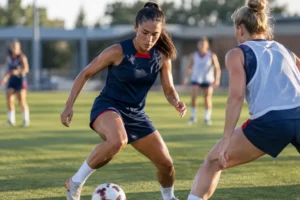


The U-17 World Cup in Morocco has already produced one result that changes the tone of the tournament: the United States’ 17-0 win over Samoa on October 19, 2026. For roster analysis, the scoreline matters less as a standalone spectacle than as a signal of distribution, finishing depth, and how quickly a youth squad can create separation in a group-stage match.
That does not mean one match should be treated as a complete tournament forecast. Youth competitions can swing sharply from one opponent profile to another, and the knockout format rewards resilience as much as attacking volume. Still, the available data from Morocco 2026 gives enough evidence to evaluate early roster trends: USA attacking depth, returnee-heavy squads, age profiles, goalkeeper size outliers, coaching origins, and the path into the Round of 16.
U-17 World Cup Roster Evidence After The Opener
Why The U-17 World Cup Scoreline Matters
The United States opened Group E on October 19, 2026 with a 17-0 win over Samoa, a result U.S. Soccer described as the biggest win in a FIFA World Cup match at any level in its official USA-Samoa match recap. Maddie DiMaria scored six goals, while ten different U.S. players scored. Loradana Paletta and Carolina Reyna each scored twice.
The distribution is the first roster point. A youth team can dominate possession and still rely on one finisher. The USA did not have that pattern in the opener. The goals were spread across the XI and substitutes, which suggests the squad had multiple routes to the penalty area and enough finishing quality to keep the tempo high after the match was already decided.
FIFA’s tournament coverage also framed the result historically, noting that the USA surpassed the previous largest margin, Morocco’s 16-0 win over New Caledonia in the men’s U-17 World Cup, in its Morocco 2026 reaction report. That context matters because it places the result beyond a routine group-stage mismatch. It became a benchmark result across FIFA youth competition.
What The Record Does Not Prove
The scoreline should not be used as proof that the USA will carry the same margin profile through Morocco 2026. Samoa’s tournament situation, the match state, and early goals all shaped the final number. Strong teams still have to manage tighter matches, set-piece defending, transitions, and emotional control when the knockout stage removes recovery time.
For roster evaluation, the stronger takeaway is not the 17 goals alone. It is that multiple players handled attacking actions, the scoring was shared, and DiMaria’s finishing created a focal point without making the rest of the attack look passive. That combination is more valuable than raw goal total when assessing whether a squad can adjust across different match scripts.
USA Depth Signals Beyond The Scoreline
DiMaria’s Finishing And Shared Production
DiMaria’s six-goal match is a rare individual marker at any FIFA level, and the research notes identify her as the first player to score more than three goals in a single FIFA U-17 Women’s World Cup match. That gives the USA a clear attacking headline, but the broader roster signal sits around her: ten scorers, two multi-goal contributors beyond DiMaria, and shared assist activity.
At this age level, teams often depend on early physical advantages or one advanced attacker. The USA opener showed a different profile. The team generated enough pressure for several players to attack the box, finish second actions, and sustain chance creation. Against stronger opponents, that depth does not guarantee similar output, but it does reduce the risk of a single-player attacking plan.
Player Development Context
The USA roster also fits a wider development conversation. Youth tournament rosters are rarely only about the present tournament; they help identify who can handle travel, tactical instruction, pressure, and short rest. Readers tracking the step from U-17 to older national-team age groups can compare this event with prior pathway patterns in U.S. women’s youth development.
The current evidence supports one cautious view: the USA has a strong attacking base in Morocco 2026, but the tournament will ask for more than finishing. Defensive spacing, midfield resistance, and rotation choices will become clearer against opponents who can keep possession longer than Samoa did.
Tournament-Wide Roster Patterns
Returnees, Age Range, And Continuity
FIFA squad confirmations from October 12, 2026 included 53 players across the 24 teams who returned from the previous U-17 Women’s World Cup. Morocco and Zambia led the field with eight returnees each. That is a meaningful roster note because returning players have already experienced tournament travel, FIFA match protocols, short turnaround preparation, and the pace of international youth competition.
Returnees should not be treated as automatic match-winners. The gap between editions can include physical development, form changes, coaching changes, and shifts in role. Still, continuity gives coaches a reference point for selection and in-game trust. For Morocco and Zambia, eight returning players give the technical staff a larger group that understands tournament demands before the first whistle.
The age profile also deserves attention. Ghana’s Belinda Kpentey was listed as the youngest player at the finals at 14 years and 54 days old on her first match, and she was one of four players born in 2012 selected for the tournament. That is not only a trivia point. It shows how wide the development bands can be in U-17 competition, where one player may be close to the upper age limit while another is still at the start of the cycle.
Roster Data Snapshot
| Roster Area | Supported 2026 Detail | Analytical Read |
|---|---|---|
| Returning Players | 53 across all 24 teams; Morocco and Zambia with eight each | Continuity can aid early tournament stability |
| Youngest Player | Ghana’s Belinda Kpentey at 14 years and 54 days on her first match | Age gaps can shape physical and tactical roles |
| Appearance Chase | Mexico’s Citali Reyes had played 10 matches across the previous two editions | Three more appearances would put her on record pace |
| Coaching Origin | Five teams had foreign coaches: Australia, Canada, Chile, Puerto Rico, and Samoa | Most teams were led by domestic coaches |
| Height Outlier | Nigeria goalkeeper Jane Ijirigho listed at 1.92 meters | Goalkeeper size can affect set-piece and crossing matchups |
Mexico’s Citali Reyes is one of the most interesting continuity cases. The research notes credit her with 10 matches across the previous two FIFA U-17 Women’s World Cups. If she adds three more in Morocco 2026, she would become the all-time tournament appearance leader, moving beyond names such as Deyna Castellanos.
Height data adds another scouting layer. Nigeria’s Jane Ijirigho, at 1.92 meters, was listed as the tallest player at the tournament, ahead of Poland goalkeeper Hanna Buchta at 1.82 meters. Kenya defender Pauline Namisi, at 1.45 meters, was listed as the shortest player. Those measurements do not define player quality, but they can affect how teams defend corners, attack wide service, and match up in penalty-area traffic.
Knockout Format And Cautious Contender Reads

Group Structure Shapes Risk
The tournament format gives teams more than one path to the Round of 16: the top two teams in each of the six groups advance, along with the four best third-placed sides. That structure changes group-stage incentives. A heavy win can help goal difference, but avoiding damaging losses can be just as important for teams fighting for third-place qualification.
That is where the USA’s opening margin carries practical value. A 17-goal difference creates a large cushion in group math, but it should be separated from knockout expectations. Once the bracket begins, a team’s ability to win lower-scoring matches becomes the stronger test.
Evidence-Based Team Reads
The safest contender read from the first week is that the USA has already shown elite attacking depth in one match. Morocco and Zambia have the clearest returnee continuity markers. Mexico has a notable individual tournament-experience storyline through Reyes. Nigeria has a goalkeeper size outlier that could matter in aerial phases. None of those facts, on their own, identify a winner.
At the U-17 World Cup level, evidence should be weighted carefully. One-sided matches can reveal quality, but they can also reflect large developmental gaps between programs. Returnees bring experience, but not all returning players keep the same role. Younger selections can be high-upside development choices, but the data does not support assuming immediate impact.
For readers using the tournament as a roster scouting window, the best method is to separate confirmed production from projection. Confirmed production includes DiMaria’s six goals, ten U.S. scorers, and the USA’s record margin. Projection begins when trying to apply those facts to future opponents. The first is supported; the second requires caution.
What Morocco 2026 Says About U-17 World Cup Rosters
Depth Is The Main Early Separator
Morocco 2026 has already reinforced a familiar youth-tournament principle: roster depth often shows before tactical detail does. The USA’s opener made that visible through scoring spread. Morocco and Zambia’s returnee counts show a different kind of depth, built around tournament familiarity. Mexico’s Reyes shows the value of repeated exposure across editions.
Those roster types are not identical. Scoring depth can decide a mismatch early. Experience can help a team manage pressure. Physical profiles can tilt certain set-piece battles. Coaching continuity can simplify tournament preparation. The strongest teams usually combine several of those categories rather than relying on one.
Coverage across the sports network, including the related site Wikiapp, often tracks these player-development patterns because youth tournaments can reveal how federations build depth before senior-level selection becomes the focus.
The Supported Read After The First Week
The evidence from Morocco 2026 supports a measured view. The USA delivered the tournament’s defining early performance on October 19, 2026 and showed attacking range that must be taken seriously. Morocco and Zambia entered with the strongest returnee counts. Ghana’s Kpentey highlighted the lower end of the age curve, while Reyes entered with a chance to rewrite the appearance record if Mexico played enough matches.
The most reliable analysis is not a fixed prediction. It is a hierarchy of evidence. Results show current execution. Roster data shows structure. Age and size profiles show matchup variables. The knockout format shows why goal difference and third-place pathways matter. Through that lens, Morocco 2026 is already a strong case study in how youth squads balance immediate performance with long-term player development.