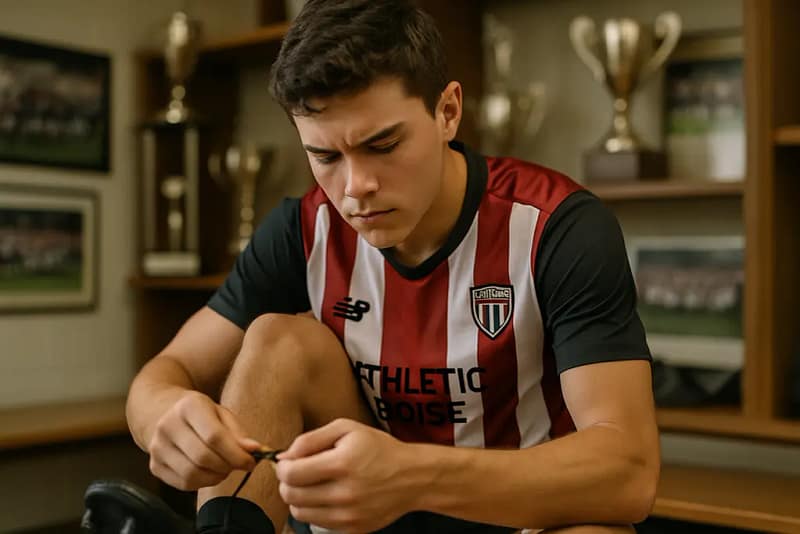

Athletic Club Boise has moved from first-year success story to a larger test of local soccer capacity. On September 9, 2026, the club announced that it will join the USL Championship for the 2027 season, taking Idaho into Division II professional soccer. The move is not just a badge change. It links on-field evidence, attendance demand, stadium work, and player-development expectations into one measurable step for the Boise market.
The safest way to read the move is through what has already been documented. The club’s announcement set the league transition date and named the facility plan. USL League One’s own analysis supplied the competitive profile behind the decision. Those two strands matter because promotion into a higher division should be judged by more than ambition; it should be judged by performance indicators, operating scale, and whether the local base has already shown consistent support.
Athletic Club Boise Promotion Timeline
What Athletic Club Boise Announced
Athletic Club Boise announced on September 9, 2026, that it will move from USL League One to the USL Championship in 2027, bringing Division II professional soccer to Idaho. The same release stated that the club is expanding its stadium at Expo Idaho with 3,000 additional east-side seats, a new practice pitch, and a training facility for the men’s and women’s teams before the 2027 season, according to the club’s official announcement.
That sequencing is significant. The club did not separate league entry from venue and training investment. In practical team-building terms, the move asks the organization to raise standards in three linked areas: matchday capacity, daily training environment, and roster readiness. None of those areas guarantees results in the USL Championship, but each is part of how clubs reduce friction when moving up a division.
Why Expo Idaho Matters
The stadium expansion is also a local-soccer signal. Adding 3,000 seats on the east side responds to demand that was already visible during the 2026 campaign. The club reported that it averaged about 7,200 attendees per home match and sold out every home game, with a peak crowd of 7,247 on June 20, 2026. Those figures give the USL Championship move a stronger base than a purely aspirational market pitch.
Attendance is not the same as long-term competitive strength. It does, though, affect the operating conditions around the first team. A larger crowd can support matchday revenue, sponsorship value, and the public profile of local players coming through the system. For a new professional soccer market, repeated sellouts are useful evidence that the club had already created habits around home matches before stepping up in division.
What The Numbers Say About Athletic Club Boise
Attacking Output Before Promotion
The on-field case was not built only on crowds. In its first season across league and Prinx Tires USL Cup competition, Boise played 28 games and scored 46 goals, ranking fifth in goal scoring across those competitions. USL League One also reported that Boise’s expected goal differential was plus-13.11, second among League One teams including cup play, behind Union Omaha, in its League One analysis.
For Athletic Club Boise, those numbers point to a team that was not winning attention only through novelty. A plus expected-goal profile suggests that chance quality and chance prevention were both favorable across the sample cited by the league. The wording still matters: this was a League One and cup-play sample, not a USL Championship season. The higher division will bring different squads, deeper benches, and a longer-term test of whether Boise’s underlying numbers can travel.
Cup Results As A Competitive Signal
Boise’s cup results against USL Championship opposition give the transition a clearer performance reference. On April 28, 2026, the club drew Las Vegas Lights FC 1-1 in regulation and advanced on penalties. On May 18, 2026, Boise beat Monterey Bay FC 4-3 after trailing 3-1 at halftime. Those matches do not prove that a team is already Championship-ready across a full schedule, but they do show that Boise handled specific higher-division opponents under competitive conditions.
The comeback against Monterey Bay is particularly useful analytically because it shows more than a single defensive stand or penalty outcome. Coming from two goals down required attacking volume and game-state resilience. The Las Vegas result showed a different skill set: staying level through regulation and managing a shootout. Together, they offer a limited but relevant snapshot of how Boise responded when the opponent came from the division it is set to enter.
Local Soccer Impact In Boise
Attendance As A Market Indicator
The local impact begins with visibility. Before its first-ever match, the club had sold more than 6,000 season tickets. By the September 2026 announcement, it had built a social media audience approaching 45,000 followers and surpassed 17.3 million broadcast views since January 2026. Those figures show that interest extended beyond single-match curiosity.
From a player-and-team-performance lens, that matters because local soccer cultures are built through repetition. Young players see the professional game nearby. Coaches can point to a local pathway. Sponsors have a clearer product to support. Families have a regular soccer event on the calendar. The promotion itself does not create a development system overnight, but the club’s early attendance and audience numbers give Boise a stronger platform than many new markets have at this stage.
There is also a wider sports-market point. Boise’s case sits within a growing set of mid-sized American markets trying to prove that professional soccer can hold steady outside the largest metro areas. For readers tracking league economics beyond Boise, this site has also covered the USL revenue sharing model. Sports enthusiasts interested in comparing cross-market strategies can explore coverage at Dashers Hockey, where similar themes of market-building are addressed, though Boise is focused on soccer demand, facility expansion, and competition within the USL structure.
Development Benefits Need Proof
The planned training facility and practice pitch are the most direct development pieces in the announcement. Better daily infrastructure can support first-team preparation, academy alignment if the club builds that structure, and shared standards across the men’s and women’s programs. The research does not provide staffing plans, academy enrollment, player pathways, or recruitment budgets, so any stronger claim would go beyond the verified record.
What can be said is narrower but still meaningful: facility investment before the 2027 season gives the club a chance to align its training environment with a higher competitive tier. That is especially relevant for roster evaluation. USL Championship clubs often need greater depth because the week-to-week standard is higher than League One, and the margin between starters and reserves can be exposed faster. Boise’s front office will be judged by how well the roster matches that new weekly demand.
Athletic Club Boise And Local Soccer Standards
The Championship Benchmark
Athletic Club Boise now has a clear benchmark: the club must carry its League One efficiency, home support, and Cup competitiveness into a tougher division in 2027. The confirmed facts make the promotion credible. The team scored at a strong rate across the cited 28-match sample, posted a strong expected-goal differential, sold out home matches, and announced physical upgrades tied directly to the move.
The cautious read is that the transition has earned attention but still requires evidence at the new level. Cup wins over Championship opposition are valuable, but they are isolated matchups. A full Championship campaign will test squad rotation, defensive consistency, travel management, and whether the expanded venue can keep the same matchday intensity after capacity grows.
For Boise soccer, the key change is standard-setting. The local market now has a Division II club, a larger stadium plan, and a competitive reference point from 2026. That combination gives players, coaches, supporters, and civic partners a more concrete soccer target. The next useful evaluation will come from verified roster construction, announced technical-staff decisions, and results after the club begins USL Championship play in 2027.