
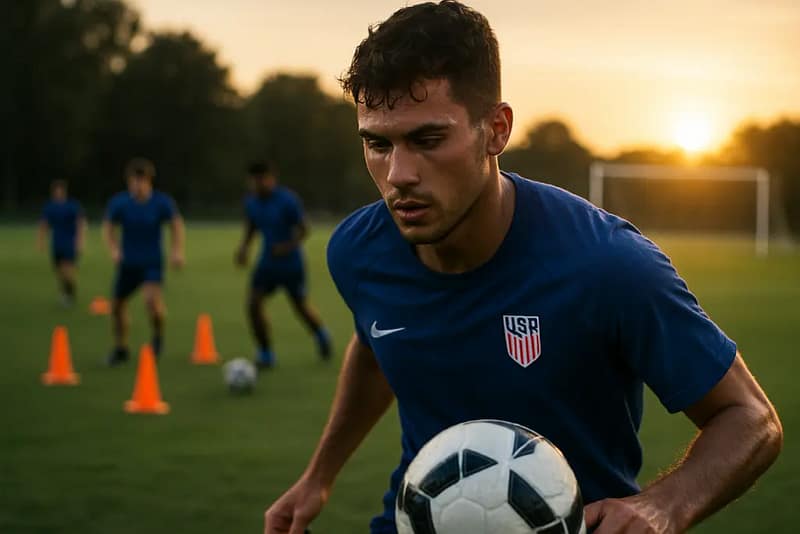

USMNT Young Talents became the main performance story of the September 2026 fall camp after Mauricio Pochettino used a youth-heavy roster and then saw several debutants directly affect the 4-1 win over Peru on September 26, 2026. The roster itself signaled the direction: 28 players, 13 uncapped, and an average age close to 22 years and 9 months, with U.S. Soccer introducing the uncapped group before camp through its fall camp player profiles.
That does not make every young player a confirmed senior-team solution. It does, however, give analysts a clearer data point than a training-only call-up. The Peru match created game evidence: debut goals, teenager minutes, and a younger starting XI than Pochettino had previously used with the U.S. men. For a detailed look across related reference materials, check out wikiapp.org, which provides extensive background contexts within the same network.
What The Fall Camp Roster Actually Showed
USMNT Young Talents And The Debut Load
The central roster fact was not just youth. It was youth combined with limited senior international experience. Before the Peru match, the uncapped players had no senior caps, and the full 28-player group averaged only 17 caps. That is a narrow experience base for a national team camp, even with Tyler Adams present as the most experienced player in the squad at 59 caps.
The 13 uncapped selections made the camp a practical test of player pathway work. It moved the discussion from academy reputation and MLS form toward senior international translation. A player can be effective for a club in a familiar role, with club teammates, weekly rhythm, and established responsibilities. A national team debut is different: shorter preparation time, less chemistry, and an opponent with its own international structure.
That is why the Peru match mattered as more than a friendly result. Eleven U.S. players made senior national team debuts on September 26, 2026, and eight of them were teenagers. Three debutants started: Cavan Sullivan, Peyton Miller, and Justin Ellis. That scale of introduction is unusual enough to treat the match as a real evaluation marker, while still being careful not to overstate one game.
Why USMNT Young Talents Defined The Peru Test
Debut Goals Versus Peru
The clearest evidence for USMNT Young Talents came on the scoreboard. Justin Ellis, 19, and Julian Hall, 18, both scored on their senior U.S. debuts in the 4-1 win over Peru. Ellis opened the scoring in the fourth minute, which U.S. Soccer’s postmatch notes described as the fastest debut goal in the modern era for the USMNT.
That early goal is useful analytically because it reduces one of the common unknowns with young attackers: whether they can enter a senior international match without needing a long adjustment period. It does not prove that Ellis is ready for a fixed role in a top-choice squad, but it does show that his club production translated quickly into one senior-team moment.
Hall’s goal carried a different kind of value. A teenage substitute scoring on debut gives staff a read on game-state readiness. Bench minutes for young players can be harder than starts because rhythm is limited and the match has already settled into patterns. Hall’s ability to contribute after entering the match gave the staff a positive short-sample indicator.
The wider team pattern was just as notable: every U.S. goal against Peru involved a debutant, either through a goal, an assist, or winning the penalty. That does not mean the debutants drove every phase of the match. It does mean their final-third involvement was visible in the most direct actions.
Club Form Behind The New Faces
MLS Production Before Camp
The club-form case for USMNT Young Talents was not built from reputation alone. Ellis entered camp with 3 goals and 11 assists across all competitions for Orlando City. That profile suggested chance creation as much as finishing, which made his fourth-minute debut goal against Peru an interesting twist: he was called in with creative production, then immediately supplied a scoring action himself.
Peyton Miller arrived with another production-heavy résumé for a young player. U.S. Soccer listed him with seven goals and four assists in his third season with New England Revolution, and his two-goal performance the weekend before camp earned MLS Player of the Matchday recognition. He also signed his first MLS contract at age 15, which places his senior exposure on a longer timeline than his age alone may suggest.
Zavier Gozo brought a different development marker. He had 6 goals and 4 assists for Real Salt Lake in the prior season before a transfer to Crystal Palace. That move does not guarantee a senior U.S. role, but it does place him in a development environment that the national team staff will be able to track against higher training demands and a different competitive setup.
Adri Mehmeti, 17, entered camp after 1 goal and 4 assists in his first full season with Red Bull New York. Neil Pierre, 18, gave the defender group an unusual attacking data point: 4 goals in 10 MLS appearances and a club single-season record for goals by a defender. Those numbers matter because they show why the staff looked beyond traditional age hierarchy, though defensive reliability still requires evaluation beyond scoring output.
| Player | Age In Research | Supported Evidence | Evaluation Note |
|---|---|---|---|
| Justin Ellis | 19 | 3 goals, 11 assists entering camp; debut goal vs. Peru | Showed quick senior-game impact after strong club creation numbers. |
| Julian Hall | 18 | Scored on senior debut vs. Peru | Bench contribution gave staff a useful late-game reference point. |
| Peyton Miller | Teenager | Seven goals, four assists with New England; started vs. Peru | Production and starting role made him one of the more visible camp tests. |
| Neil Pierre | 18 | Four goals in 10 MLS appearances | Attacking output is notable, but center-back assessment remains broader. |
How The Teen Minutes Changed Evaluation
Experience Gap And Veteran Balance
Cavan Sullivan’s case carried the most historical attention. The Washington Post reported before the match that Sullivan, then 16, was set to turn 17 on September 28, 2026, two days after the Peru game, and that a debut would place him among the youngest U.S. men since Freddy Adu in January 2006 through its Sullivan roster report. Sullivan did make his debut against Peru at 16 years and 363 days, becoming the fourth-youngest modern-era American to earn a cap, according to U.S. Soccer’s postmatch notes.
That cap should be read with restraint. A debut at that age is a major marker of trust, but it is not the same as a settled role. For a 16-year-old forward, the evaluation must include physical adaptation, decision speed, off-ball work, and repeatability across multiple camps. The value of the Peru appearance was that it gave staff a senior reference point without needing to project only from club or youth-team settings.
Tyler Adams’ presence helped frame the age imbalance. Adams captained the team against Peru for the first time since the 2022 World Cup, according to U.S. Soccer’s match notes. In a squad with so many first-cap players, a midfielder with 59 caps can help stabilize spacing, defensive communication, and pressing cues. That veteran layer matters because young-player evaluation is cleaner when the team structure does not collapse around them.
Malik Tillman and Sebastian Berhalter also gave the match a bridge between established and emerging contributors. Tillman scored his third U.S. goal of 2026 and earned his 36th cap. Berhalter recorded both a goal and an assist. Those contributions reduced the risk of treating the Peru match as only a youth showcase. It was closer to a mixed-group test, with teenagers and debutants supported by players who had already spent more time in the senior setup.
For more roster-balance context from the same coverage cluster, the related USMNT roster analysis connects the September-October squad structure to the broader mix of World Cup veterans, uncapped players, and MLS youth.
USMNT Young Talents In Fall Camp Context
The value of USMNT Young Talents in this camp was that their involvement produced both selection evidence and match evidence. The selection evidence came first: a 28-player roster with 13 uncapped players and one of the youngest squad profiles in recent senior-team windows. The match evidence followed against Peru: 11 debuts, eight teenage debutants, two teenage or near-teen debut scorers, and debutant involvement in all four U.S. goals.
The caution is equally clear. One friendly win does not settle depth charts, World Cup roster plans, or long-term senior roles. International football often punishes small-sample certainty. Opponent quality, match state, venue, lineup balance, and the presence of senior anchors all shape how young players look.
Still, September 26, 2026 gave Pochettino and the U.S. staff a useful reference point. Ellis showed immediate penalty-box impact. Hall converted a debut chance. Sullivan became a historically young cap. Miller’s club form and starting role gave the staff a two-way evaluation case. Pierre, Mehmeti, and Gozo added different player-development profiles that can be monitored beyond one camp.
The strongest read is measured rather than sweeping: the fall camp did not prove that the next generation is ready as a group, but it did show that several young players could handle a senior national team window without looking out of place in decisive moments. That is meaningful evidence for roster planning, especially because the match contributions came from multiple debutants rather than one isolated breakout.