

The AFC East no longer feels like a division waiting for someone to challenge Buffalo. It feels like a division trying to decide whether Buffalo is still the standard at all. The Bills enter late July with continuity, Josh Allen, and a new head coach in Joe Brady. The Patriots enter with the defending AFC champion profile, Drake Maye’s rise, and A.J. Brown changing the shape of their offense. The Dolphins arrive in Miami Gardens with a full offensive reset. The Jets come to Florham Park trying to turn another rebuild into something more than summer optimism.
That is why AFC East training camp matters in 2026. The division will not be decided by one July practice, but late July will reveal which teams are actually ready to live inside their offseason stories. Buffalo wants to stay ahead. New England wants to prove it has already passed the old order. Miami wants to show its rebuild has structure. The Jets want to prove that another reset is not just another reset.
Why The AFC East Starts With Buffalo’s New Era
The Bills still carry the division’s most stable football identity. NFL.com’s AFC East training camp preview listed Buffalo’s 2025 record at 12-5 and framed the summer around a new era under Joe Brady, who takes over from Sean McDermott after years of sustained success. That makes Buffalo’s camp at St. John Fisher University in Rochester more than a normal ramp-up. It is the first public test of whether the Bills can change leadership without losing their structure.

Brady’s job is not to reinvent the Bills from scratch. It is to unlock a team that has been close enough to matter but not close enough to finish the job. That begins with Allen. Buffalo’s camp has to show whether Brady can give his quarterback more control without making the offense more chaotic. The Bills have long been dangerous because Allen can turn broken plays into punishment. The next step is making sure the offense does not need constant improvisation to stay efficient.
That is where training camp becomes revealing. Practice reports about timing, route discipline, offensive tempo, and red-zone execution will say more than preseason quotes about excitement. If Buffalo looks organized early, the Bills can treat Brady’s arrival as a refresh rather than a reset. If the offense looks disjointed, the AFC East will sense an opening.
How DJ Moore Changes The Bills’ Receiver Question
Buffalo’s receiver room is the biggest offensive camp storyline because DJ Moore arrives with a specific job: give Allen a true WR1-style outlet and help stabilize a group that has been searching for its post-Stefon Diggs identity. NFL.com noted that Moore is reuniting with Brady, his former Panthers offensive coordinator, and that Buffalo needs him to raise the level of a receiver room built around Khalil Shakir, Keon Coleman, Josh Palmer, Brandin Cooks, and others.
The Moore-Allen connection has to become real before September. Training camp is where that happens. Deep-ball timing, third-down trust, scramble-drill chemistry, and red-zone leverage cannot be built only in meetings. Moore must learn how Allen sees pressure. Allen must learn which windows Moore can win. Brady must decide how much of the passing game can run through Moore without shrinking everyone else.
Keon Coleman’s camp also matters. If Moore gives Buffalo a primary receiver and Coleman takes a step forward, the Bills can stretch defenses in ways they struggled to do consistently. If Moore is good but the room behind him remains uneven, Buffalo may still look like an Allen-dependent team.
World Football Idol’s earlier look at NFL training camp readiness argued that late July exposes whether offseason fixes are real. Buffalo’s receiver room is exactly that kind of test.
Why New England Is No Longer Just Chasing Buffalo
The Patriots are the reason Buffalo cannot treat the AFC East as a familiar hierarchy. New England’s 14-3 record in 2025 changed the division’s psychological map, and its offseason trade for A.J. Brown made the Patriots more than a defense-and-quarterback development story. They now have a headline receiver paired with Maye, who has already pushed the franchise’s timeline forward.
NFL.com framed New England’s camp around upgraded weaponry, with Brown already building chemistry with Maye during minicamp. That is the kind of detail that can either become a passing comment or the first sign of a division shift. If Brown and Maye look sharp in Foxborough, the Patriots can enter September with the most complete offensive ceiling in the East.
The internal pressure is different from Buffalo’s. The Bills are trying to stay in control. The Patriots are trying to prove their sudden rise is repeatable. New England cannot afford a camp built on last season’s aura. It needs Brown to fit, Romeo Doubs to settle into a strong secondary role, and young receivers such as Kyle Williams to provide enough depth that Maye is not forced into a narrow offense.
World Football Idol’s analysis of Drake Maye’s Patriots rise already captured why New England’s timeline feels accelerated. Training camp is where that acceleration either looks sustainable or overhyped.
How Miami’s Offensive Overhaul Changes The Division Math
Miami is the wild card because the Dolphins no longer look like the speed-driven offense that defined their recent identity. NFL.com’s preview laid out the scale of the change: Tua Tagovailoa, Tyreek Hill, and Jaylen Waddle are out, Malik Willis is in, and De’Von Achane has re-signed for the long haul. That is not a tweak. That is a full offensive transformation.
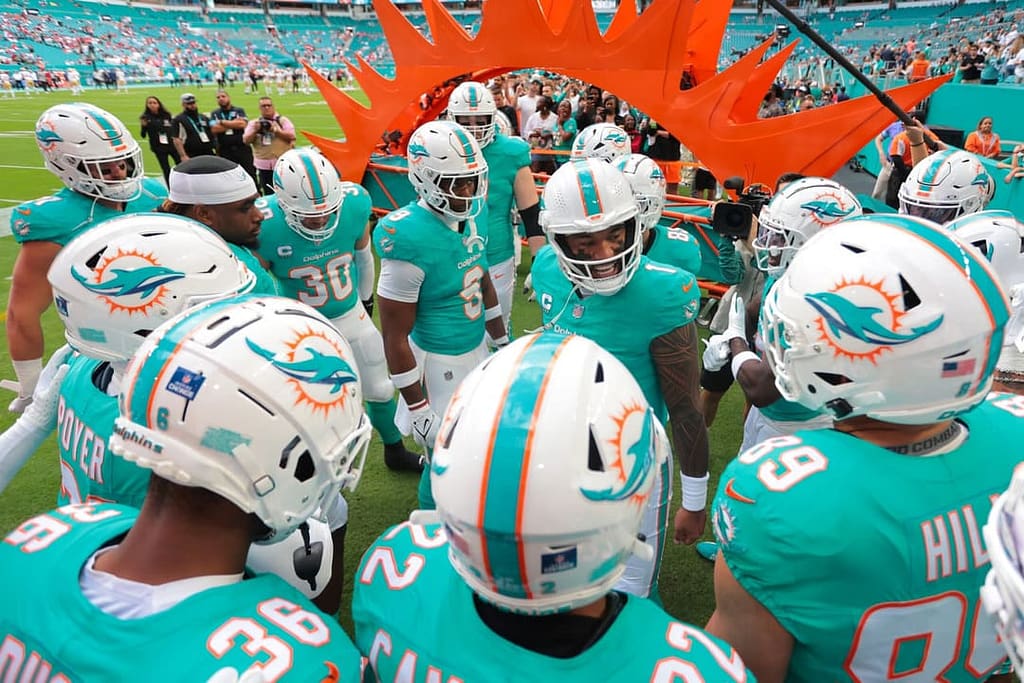
The Dolphins’ camp at the Baptist Health Training Complex in Miami Gardens will reveal whether Jeff Hafley and general manager Jon-Eric Sullivan have built a transition plan or simply inherited a rebuild. Willis is the central figure because his three-year contract suggests he is the quarterback of the present, but his first full summer as Miami’s starter will define how believable that present is.
Miami’s new receiving group also has to sort itself quickly. Malik Washington, Tutu Atwell, Jalen Tolbert, Terrace Marshall Jr., Jalen Reagor, and young additions such as Chris Bell, Kevin Coleman Jr., and Caleb Douglas create competition, but competition is not the same as clarity. Willis needs reliable answers. Hafley needs to know whether Miami can build a functioning passing game around new names before the division schedule starts.
The Dolphins may not need to win the AFC East in 2026 for camp to be considered successful. They do need to show they are not drifting. A sloppy camp would reinforce the idea that Miami has fallen behind the Bills and Patriots. A focused camp would at least make the Dolphins a more dangerous spoiler in a division that may be tighter than the standings suggest.
Why The Jets’ Camp Is About Credibility
The Jets’ problem is not that they lack storylines. It is that they have had too many storylines and too few answers. NFL.com listed New York’s 2025 record at 3-14 and pointed to a historically poor defensive takeaway profile, a remade defensive roster, and another quarterback reset with Geno Smith returning to the franchise that drafted him.
That makes Jets camp in Florham Park a credibility test. Aaron Glenn and the new staff need signs that the defense can do more than look improved on paper. The additions of Demario Davis, Minkah Fitzpatrick, T’Vondre Sweat, David Onyemata, Joseph Ossai, and Nahshon Wright give the Jets veteran presence and physicality, but camp will show whether Brian Duker’s defense can communicate, tackle, and finally take the ball away.
The offense may be just as important. Smith gives the Jets a veteran quarterback with a chance to stabilize the operation, while Garrett Wilson and Breece Hall remain the skill-position anchors. Adonai Mitchell, Kenyon Sadiq, and Omar Cooper Jr. add youth around them, and the offensive line returns four of five starters with Dylan Parham set to replace John Simpson at left guard.
That is a legitimate football foundation. The problem is history. Jets fans have heard about legitimate foundations before. Camp has to produce fewer slogans and more evidence: cleaner passing-game timing, fewer protection issues, more defensive takeaways, and a roster that looks competitive before the preseason even begins.
The Camp Battles That Could Decide The Division Tone
The AFC East will be shaped by different camp questions because each team is at a different stage. Buffalo’s question is whether a strong roster can adjust to a new head coach. New England’s question is whether a fast-rising contender can handle new expectations. Miami’s question is whether an offensive reboot can become coherent. New York’s question is whether another reset can finally become durable.
| AFC East Team | 2025 Record | Key Camp Question | Why It Matters |
|---|---|---|---|
| Buffalo Bills | 12-5 | Can Joe Brady maximize Josh Allen while integrating DJ Moore? | Buffalo must protect its division standard |
| New England Patriots | 14-3 | Can A.J. Brown and Drake Maye become a true top-tier pairing? | New England is trying to prove its rise is sustainable |
| Miami Dolphins | 7-10 | Can Malik Willis lead a rebuilt offense without Hill, Waddle, and Tagovailoa? | Miami needs identity before it can chase relevance |
| New York Jets | 3-14 | Can the new defense and Geno Smith-led offense create credibility? | The Jets need proof after years of resets |
The table shows why late July is so important. These are not small roster notes. They are identity questions. Each team’s camp will reveal whether its offseason direction matches its actual football capacity.
Why The Bills’ Edge Rush Could Be The Hidden Swing Factor
Buffalo’s offense gets the attention, but the pass rush may decide whether the Bills can stay above the division. NFL.com identified Bradley Chubb as one of Buffalo’s critical additions after he posted 8.5 sacks for Miami in 2025 and stayed healthy for a full season for the first time since his rookie year. The Bills needed edge help after Gregory Rousseau led them with only seven sacks last season.
Chubb is more than an offseason name. He is a camp temperature check. If he looks explosive, Buffalo’s defense immediately gains a different ceiling. If he looks like a veteran managing his body through camp, the Bills may still have a pass-rush question. Second-round pick T.J. Parker adds another layer because Buffalo cannot rely only on Chubb to solve a postseason pressure problem.
This is where the AFC East becomes less about quarterbacks and more about disruption. Maye, Willis, and Smith will all test Buffalo’s defense differently. If the Bills can pressure without overcommitting blitz help, they remain the division’s most stable contender. If they cannot, New England’s upgraded offense becomes even more dangerous.
How New England’s Defense Could Protect Its Offense
The Patriots’ offensive upgrades will dominate headlines, but their defense remains central to whether they can stay ahead of Buffalo. NFL.com highlighted two defensive availability questions: Christian Gonzalez’s contract situation and Gabe Jacas’ delayed start after an offseason medical procedure. Gonzalez’s presence matters because elite cornerbacks reshape what a defense can call. Jacas matters because New England traded up for him and needs pass-rush depth.
The Patriots are not rebuilding. They are defending a new standard. That makes camp sharper. If Gonzalez is present, focused, and healthy, New England’s secondary can remain one of the division’s most reliable units. If Jacas arrives ready to contribute, the pass rush becomes deeper. If either situation becomes messy, the Patriots enter the season with avoidable uncertainty.
That is the difference between being a surprise contender and a sustained power. Sustained powers solve problems before September. New England’s camp will reveal whether it has reached that stage.
Why This AFC East Race Feels Different
The AFC East used to be framed around whether anyone could catch the Bills. In 2026, the better question is whether the Bills can keep the division from becoming a two-team fight with New England while Miami and the Jets try to reshape the middle tier.
Buffalo still has Allen, stability, and a roster built to win now. New England has the momentum, the quarterback growth, and the new No. 1 receiver. Miami has a reset that could either bottom out or become more competitive than expected if Willis stabilizes the offense. The Jets have enough veteran talent to make another 3-14 season feel unacceptable.
That makes late July unusually revealing. A clean Bills camp would calm fears about the coaching transition. A sharp Patriots camp would confirm that New England is not going away. A coherent Dolphins camp would make Miami a more complicated opponent. A serious Jets camp would turn the division’s bottom into something less predictable.
What Training Camp Will Tell Us Before Week 1
AFC East training camps will not decide the standings, but they will tell us which offseason stories deserve belief. Buffalo’s practices in Rochester will show whether Brady can modernize the Bills without disrupting Allen’s rhythm. New England’s camp in Foxborough will show whether Maye and Brown can turn chemistry into a division-changing weapon. Miami’s camp in Miami Gardens will show whether Willis and Hafley have a real foundation. The Jets’ work in Florham Park will show whether Glenn’s reset has football substance behind it.
The Bills are still positioned to stay near the top. They have the quarterback, the roster continuity, and the urgency. But the AFC East no longer belongs to them by default. The Patriots have already changed the conversation. The Dolphins and Jets have enough volatility to reshape individual Sundays, even if their longer timelines remain uncertain.
That is why late July matters. It strips away the offseason’s clean narratives and replaces them with work. Reps. Heat. Mistakes. Corrections. Injuries. Chemistry. Pressure. Depth.
The Bills can stay ahead of the Dolphins, Patriots, and Jets. But in 2026, they will have to prove it before the season starts feeling real.