
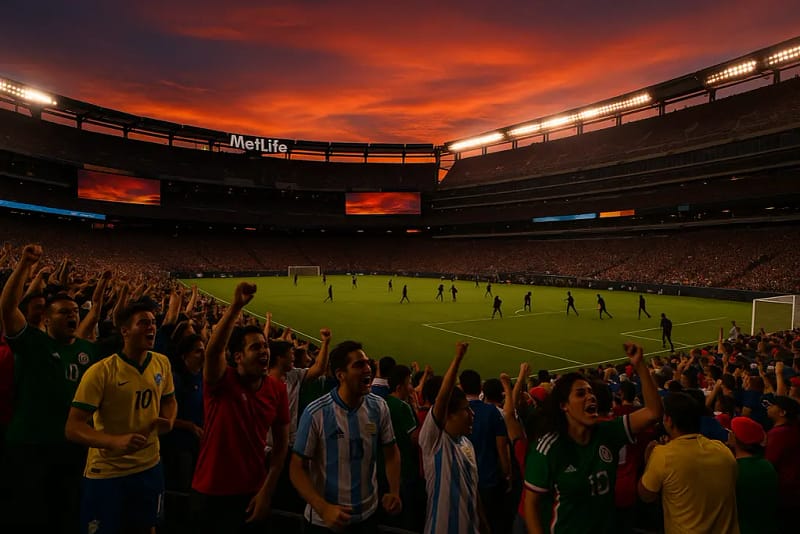

The MetLife Stadium final gives the 2026 FIFA World Cup a venue choice that is easy to defend operationally but harder to evaluate purely through a football lens. East Rutherford, New Jersey, offers a major-event setting for the tournament’s biggest match on July 19, 2026, yet the debate around the decision is not limited to capacity. It also covers field dimensions, playing surface quality, transportation, and whether the stadium’s matchday environment matches the scale of a World Cup final.
For a final, the venue is not only a backdrop. It affects preparation, player comfort, tactical rhythm, crowd movement, and the way the tournament is remembered. That is why the discussion around MetLife should be treated as a venue-performance question rather than a simple city-versus-city argument.
Why The MetLife Stadium Final Matters
A Selection Built On Capacity And Control
FIFA’s choice places the final in one of the largest stadiums assigned to the tournament, but the final configuration will not match the building’s usual football setup. Associated Press reported that MetLife Stadium plans to remove 1,740 seats so the venue can meet FIFA’s 75-by-115-yard field requirement, reducing soccer capacity from 74,895 to about 73,155 for the tournament through this AP venue report.
That adjustment is significant because it shows the trade-off at the center of the decision. FIFA-grade soccer requires a wider, longer playing surface than many American football stadiums can naturally support. A venue may look ready from the outside, but the final test is whether it can provide the correct field geometry without compromising sightlines, stadium operations, and player conditions.
MetLife Stadium Final Trade-Offs
The MetLife Stadium final is therefore not simply a reward for stadium size. It is a test of conversion quality. A reduced-capacity configuration can still serve a global final if the field performs well, the grass holds up, and the stadium manages crowd flow efficiently. The question is whether the final presentation will feel like a purpose-built football event or a major American stadium adapted successfully for football’s highest match.
That distinction matters for roster and tactical analysis as well. A final is often decided by marginal details: first touch under pressure, recovery runs in the last 20 minutes, set-piece footing, and the ability of wide players to trust the surface near the touchline. Venue readiness is not separate from match quality; it is part of the competitive environment.
The Pitch Question Is A Football Question
Field Size And Seat Removal
The seat-removal plan is the clearest measurable venue change tied to the final. It shows that the stadium’s American football architecture required adaptation to meet FIFA’s playing-area standard. From a football operations perspective, that is not unusual in North America, where several large stadiums are built primarily for NFL use. Still, the final magnifies every adjustment.
The MetLife Stadium final will be judged less by the number of seats removed than by whether the field feels natural to players. Elite national teams structure possession patterns around spacing, passing lanes, pressing triggers, and recovery angles. If the field dimensions are correct but the surface is inconsistent, the advantage of compliance becomes incomplete.
Surface Feedback From Players
Sports Illustrated cited player concerns after matches at MetLife, including France midfielder Adrien Rabiot describing the surface as “quite hard and quite rigid,” while Brazil forward Vinícius Júnior said the pitch dried out quickly in the heat and affected play. The same article also raised access and venue-design criticisms in its SI venue critique.
Those comments should not be inflated into a prediction that the final will suffer. They do, however, identify the exact area where the venue must provide evidence of improvement: surface response under summer conditions. A hard or dry pitch can change ball speed, increase technical errors, and discourage dribblers from taking risks in tight areas. For a final, that matters because the best teams often need the field to support both high-speed transition and controlled possession.
Access, Venue Feel, And Matchday Pressure
Transport Friction Around A Neutral Venue
Access criticism around MetLife is not a cosmetic issue. A World Cup final depends on controlled arrival patterns, clear transport messaging, and predictable movement before and after the match. The research record supplied for this analysis points to criticism of limited public transportation options and high parking costs around the stadium area. Those are matchday-performance variables because they shape crowd stress, security timing, and the pre-match atmosphere inside the building.
For readers tracking wider tournament operations, the same concerns connect with broader host-city readiness themes. Our analysis of Dallas World Cup security planning shows why modern mega-events are judged by much more than attendance. A stadium can be full and still create operational strain if movement, screening, and local infrastructure are not aligned.
Why Design Criticism Matters Less Than Execution
MetLife has also drawn criticism for its neutral gray appearance and for lacking certain modern features associated with newer American venues. That critique is valid as an aesthetic debate, but it should not be treated as the main sporting test. The final will not be won or lost because the building lacks a retractable roof. It may be affected, though, by heat management, turf performance, recovery conditions, and how cleanly the event is staged.
From an analyst’s standpoint, the safer judgment is this: design character can shape perception, but execution will shape the football product. If the grass plays evenly, teams can warm up properly, players trust their footing, and the crowd enters without major disruption, the stadium’s plain exterior becomes a secondary issue. If the pitch or access plan fails, the criticism becomes sharper because the final leaves little room for operational excuses.
How This Decision Fits The North American Tournament

Host-City Readiness Beyond One Stadium
The 2026 World Cup is spread across three countries, which makes venue consistency harder than in a compact tournament. Stadiums differ in climate, roof design, field history, transport networks, and local event staffing. MetLife’s selection for the final highlights that challenge because the tournament’s closing match needs the highest level of reliability after weeks of matches elsewhere.
Coverage of fan movement and non-ticketed match culture will also matter, particularly because the final attracts visitors beyond those inside the stadium. Both aspects are part of the comprehensive event planning explored on AP Levante, where infrastructure and supporter experience often intersect with the sport itself.
The Final As A Stress Test
The MetLife Stadium final will test whether an NFL venue can be converted into a World Cup showpiece without the conversion becoming the story. That is the core significance of the decision. FIFA did not choose a venue free from criticism; it chose a venue that must answer those criticisms through delivery.
For teams, the most relevant issues will be practical. Is the grass stable? Does the ball move consistently? Are hydration and warm-up routines managed cleanly? Does the venue allow players to focus on the match rather than the surface? These questions sit closer to football performance than broader arguments about stadium prestige.
What The MetLife Stadium Final Will Test
The MetLife Stadium final should be evaluated through three evidence-based measures: field quality, operational access, and whether the match environment supports elite football. The available reporting already shows that the stadium is being physically adjusted to meet FIFA dimensions, and it also shows that players and analysts have raised concerns about the surface and the stadium experience.
- Field Compliance: The venue must translate required dimensions into a surface that plays naturally for both possession and transition teams.
- Player Conditions: Heat, firmness, and grass moisture levels need management because they affect technical execution.
- Event Operations: Transport, parking, and crowd flow will influence the quality of the final-day experience.
The significance of the selection is not that MetLife is an uncontested choice. It is that the venue now carries the responsibility of proving that scale, location, and conversion planning can meet the standard expected of a World Cup final. For football analysts, the fair approach is cautious: acknowledge the stadium’s capacity and logistical ambition, but keep the focus on the measurable details that affect players and the match itself.