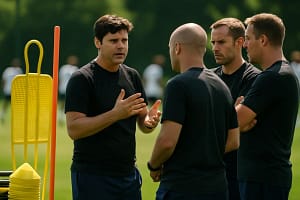
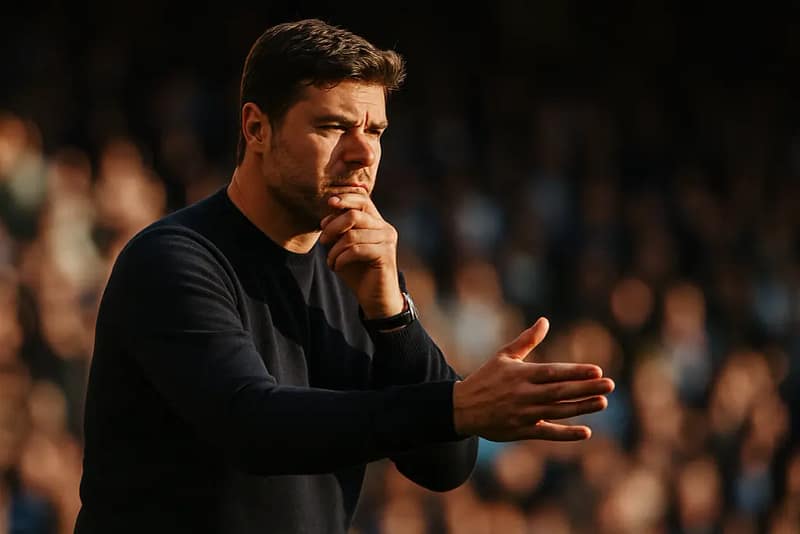

The Pochettino Contract Extension announced on August 3, 2026 changed the frame for U.S. Soccer. It did not simply keep a high-profile coach in place after the 2026 World Cup. It gave Mauricio Pochettino and his staff a longer technical brief, running through the 2030 FIFA World Cup, and expanded the discussion from match management to federation-wide standards.
That distinction matters because U.S. Soccer’s announcement said the agreement extends Pochettino through 2030 and gives his staff greater involvement in youth development, coaching education, professional league collaboration, and national-team pathways, according to the federation’s official contract announcement. For a national team that has often measured coaches by tournament windows, this is a broader bet on continuity, internal alignment, and technical authority.
Why The Pochettino Contract Extension Matters
Pochettino Contract Extension And Technical Control
The Pochettino Contract Extension matters because it changes the job description. A national-team head coach usually has limited contact time with players, a condensed match calendar, and uneven influence over development environments. This agreement gives Pochettino a wider lane. The official language points beyond senior-team tactics and toward youth teams, coaching education, and cooperation with professional leagues.
That does not guarantee better players or better tournament results. It does, however, reduce one common problem in national-team work: a senior coach asking for standards that the wider system does not teach early enough. If Pochettino’s staff can create clearer expectations across age groups, the senior team should receive players who better understand training intensity, defensive habits, positional demands, and the behavioral expectations of international football.
From Tournament Coach To System Lead
The extension also shifts internal power. Pochettino is no longer only the coach hired to steer one World Cup cycle. He is now positioned as a system lead whose influence can reach below the senior squad. That can help if the federation keeps responsibilities clear. It can hurt if authority becomes too concentrated or if youth staff feel that short-term senior-team preferences are crowding out age-appropriate development.
The most useful version of this model is not a top-down order sheet. It is a shared technical language. U-17 and U-20 players do not need to copy the senior team in every detail, but they can be taught the same core ideas: scanning before receiving, pressing triggers, transition control, recovery runs, and decision-making under pressure.
What The 2026 World Cup Tells Us
Results That Supported Continuity
The federation’s decision came after a 2026 World Cup that ended for the United States on July 6, 2026. U.S. Soccer said Pochettino set a record for most match wins by a U.S. Men’s National Team head coach at a single World Cup and led the team to a group win for only the third time. Those are meaningful data points because they show competitive progress within the specific pressure of a World Cup.
For roster evaluation, that matters. Knockout football can flatten differences between teams, but group-stage consistency usually reflects preparation, squad balance, and clarity of match plans. Winning a group does not make the national-team project complete. It does give the federation a defensible reason to choose continuity rather than restart the coaching search immediately after the tournament.
Limits Behind The Progress
The caution is just as real. The United States still exited in the last 16 on July 6, 2026. Leander Schaerlaeckens, writing for The Guardian’s analysis, argued that the return was risky, expensive, and possibly unnecessary. That critique should not be dismissed as negativity. It reflects the central tension in this deal: U.S. Soccer is paying for continuity before seeing whether the 2026 progress can become deeper knockout-stage performance.
For an evidence-based reading, the 2026 World Cup offered both support and warning. The team produced enough to justify retaining the coach. It did not produce enough to remove scrutiny from the next cycle.
Coaching Dynamics Across U.S. Soccer
Authority Below The Senior Team
The most consequential coaching change may happen away from the senior matchday bench. If Pochettino’s group has more influence over youth development and coach education, U.S. Soccer is trying to narrow the gap between national-team selection and player formation. That is a strategic move, not just a personnel decision.
The upside is coordination. A federation can waste years if youth teams, senior teams, coaching courses, and professional clubs use different standards without a shared reference point. A long contract gives Pochettino time to make those reference points clearer. The risk is rigidity. The United States player pool is wide, geographically dispersed, and shaped by several professional and academy environments. A single senior-team model cannot answer every development question.
Staff Alignment And Accountability
This also raises the bar for assistant coaches, technical staff, and federation executives. A longer agreement makes it harder to blame poor outcomes on transition. If standards, pathways, and senior-team identity are now connected, accountability becomes broader. Player selection, youth integration, coaching courses, and senior-team tactics will be judged as parts of the same project.
That is a healthy pressure if evaluation remains clear. The federation should be able to ask specific questions: Are young players entering senior camps with better tactical habits? Are coaches across age groups using consistent language? Are roster decisions rewarding form and fit rather than reputation? Are tournament plans flexible enough to handle different opponents?
Roster Evaluation Under A Longer Time Horizon

Selection Standards After 2026
A second cycle gives Pochettino more time to separate short-term form from long-term suitability. That should matter for every line of the roster. Goalkeepers need distribution and command of the box. Center backs need defensive range and composure. Midfielders need pressure resistance. Forwards need finishing, pressing, and connection play. Fullbacks need recovery pace and final-third judgment.
The extended window should make selection standards more stable. Players should know what earns a call-up, what keeps a place, and what loses one. That transparency can improve competition inside the squad. It can also protect the staff from drifting between ideas after one poor result.
Player Development Links
The agreement also gives the federation more time to connect senior needs with development priorities. If the senior team lacks a certain profile, the answer cannot only be to search the player pool every camp. The system has to ask why that profile is scarce and how earlier coaching can address it. A related site analysis on Banat Zayed explains how strategic planning is essential in making sure time is applied effectively towards clearer standards and outcomes.
- Senior roster spots should be tied to form, tactical fit, and international readiness.
- Youth pathways should prepare players for repeatable senior-team demands.
- Coaching education should define shared principles without limiting player individuality.
Business And Governance Risk
Continuity Has A Cost
The Pochettino Contract Extension also creates governance pressure. A long deal with a prominent coach signals confidence, but it reduces flexibility if results stall. U.S. Soccer has placed a major part of its 2030 project behind one technical leader and his staff. That can be efficient if the plan works. It can become expensive and politically difficult if the team underperforms in major tournaments before 2030.
That is why this is not only a soccer decision. It is a federation-management decision. Leadership has to protect the project from overreaction after one bad match, while still asking hard questions when patterns repeat. For readers interested in sport and culture across related coverage, Banat Zayed is part of the same network of sites tracking wider audience interest around major sports stories.
Why The Decision Is Not Risk-Free
The safest argument for the extension is continuity. The strongest argument against it is opportunity cost. U.S. Soccer chose not to reopen the market after the 2026 World Cup. That choice suggests the federation valued the existing foundation more than the possibility of a different tactical direction.
Both readings can be true. Pochettino earned support through measurable tournament progress. He also remains responsible for pushing the team past the last-16 barrier that framed the end of the 2026 campaign.
What The Pochettino Contract Extension Means For US Soccer
A Longer Test Of Identity
The Pochettino Contract Extension should be judged less by its announcement and more by what changes inside the program by 2030. The key evidence will be visible in player readiness, youth integration, coaching alignment, and major-tournament performance. A longer contract gives U.S. Soccer time. It does not guarantee that the time will be used well.
For the senior team, the immediate meaning is stability. For the federation, the deeper meaning is a commitment to one technical direction. For Pochettino, it is a broader mandate and a tougher evaluation. The first cycle delivered enough progress to justify continuation. The second will show whether continuity can produce a more complete U.S. Soccer structure, not just a better-prepared senior team.