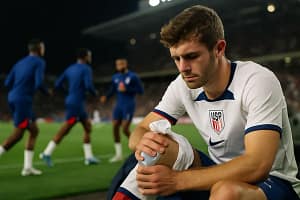


The September injury report for the late September and October 2026 international window is already shaping squad choices for several national teams. The most clearly documented updates in the available research involve England’s five-player withdrawal list, Brazil losing João Pedro from its squad, and a group of absences affecting Nigeria, the United States, the Netherlands, Spain and Canada. The main analytical point is not just which names are missing, but how those absences alter position balance, workload distribution and coaching decisions across friendlies and qualifiers.
Because national-team windows compress preparation time, even one confirmed absence can change how a coach builds training groups. Friendlies allow some experimentation, but they still matter for tactical continuity and depth evaluation. Qualifiers raise the pressure further because the points or tournament path cannot be separated from availability. This report focuses only on the confirmed withdrawals and absences provided in the research notes, with no projection on return dates beyond what was stated there.
September Injury Report Squad Changes
September Injury Report Names To Track
England had the largest confirmed group of injury-related withdrawals in the research set. Tino Livramento, Kobbie Mainoo, Cole Palmer, Marcus Rashford and Declan Rice all withdrew from the England squad update announced on 21 September 2026, with England scheduled to face Spain on 26 September, Czechia on 29 September, Croatia on 3 October and Czechia again on 6 October, according to the official England squad update.
That is a broad positional hit rather than a single-role issue. Livramento’s absence affects full-back depth. Mainoo and Rice affect midfield structure in different ways, with Rice carrying particular value as a defensive midfielder and set-piece presence. Palmer and Rashford remove attacking options who can work between lines or attack wide channels. Without adding unsupported replacement details, the confirmed picture is enough to show why England’s coaching staff must redistribute minutes and responsibilities across several units.
Brazil’s confirmed issue is more targeted. João Pedro withdrew from Brazil’s squad before friendlies against Australia on 1 October 2026 and India on 12 October 2026 after injury concerns linked to a knock during club play, as reported by FourFourTwo’s João Pedro update. For Brazil, the impact is concentrated in the forward group. The team still has a friendly window to assess alternatives, but the absence removes one attacking option during a useful testing period.
Why Confirmed Absences Matter Before Friendlies
The September injury report should be read differently for friendlies than for competitive matches. In a friendly, a withdrawal can create a chance for another player to earn minutes without forcing a major tournament consequence. In a qualifier, the same withdrawal can change a starting plan and the match-management options on the bench. The research includes both kinds of fixtures, so the injury lens has to stay tied to match context.
Nigeria’s case sits on the competitive side. Victor Osimhen was ruled out of Nigeria’s opening 2027 AFCON qualifiers against Madagascar on 25 September 2026 and Guinea-Bissau on 29 September 2026 because he was still recovering from a right adductor muscle strain sustained while playing for Galatasaray. That is a major centre-forward absence in matches tied directly to qualification, not a lower-stakes evaluation window.
The United States also had a forward-line change in the research. Ricardo Pepi was set to miss the fall international window after suffering an injury during PSV Eindhoven’s match against FC Twente, with Damion Downs replacing him in the 28-man U.S. squad. For readers following the American pool in more detail, our related USMNT injury report looks at the roster depth question from a U.S.-specific angle.
Team-By-Team Absence Impact
England And Brazil Carry Different Risk Profiles
England’s situation is about volume and distribution. Losing five players at once forces the staff to reassess more than one phase of play. The squad has to cover full-back minutes, midfield ball-winning, progression through central areas and wide or half-space attacking roles. In a four-match run from 26 September to 6 October 2026, that matters because load can accumulate quickly, especially if replacement options need time to settle.
Brazil’s situation, based on the available research, is narrower but still relevant. João Pedro’s absence does not create the same multi-unit disruption as England’s list, but it does affect the attacking evaluation plan. Friendlies against Australia and India can serve as tests for forward combinations, pressing cues and penalty-area movement. Removing one forward from that plan changes the sample the staff can assess.
Netherlands, Spain And Canada Add Different Types Of Absence
The Netherlands had Justin Kluivert withdraw from the Dutch squad as of 20 September 2026 after sustaining an injury in the Europa League against Real Sociedad. The research notes state he was expected to be out for several weeks and would miss the upcoming international fixtures. That affects wide and attacking-midfield depth under new head coach Xavi Hernández, based only on the role profile implied by the player’s position and the confirmed absence.
Spain had Pedro Porro withdrawn by manager Luis de la Fuente from a 25-player Nations League roster announced on 19 September 2026 after he was injured in Tottenham’s match against Aston Villa earlier that day. Spain’s Nations League matches begin in late September. The practical effect is at right-back or wing-back depth, depending on the tactical shape used. Without confirmed replacement information in the approved research set, the cautious read is simple: Spain lost a selected defender before the window opened.
Canada’s case is different because Alphonso Davies’ absence was not injury-related. The research states he will not be selected for Canada’s friendlies in the September-October 2026 window against Chile, Peru and the USA because he is taking a belated honeymoon after marrying in Paris. From a squad-strength view, the absence still matters. From an injury-report view, it should be separated clearly from medical withdrawals.
Roster Pressure Points By Position
The confirmed absences cluster around several important roster zones: centre-forward, full-back, central midfield and wide attack. That distribution matters because international coaches have fewer training sessions than club coaches. They are not only replacing individual players; they are replacing chemistry, pressing timing, defensive coverage and set-piece roles.
| Team | Confirmed Absence | Fixture Context | Primary Squad Effect |
|---|---|---|---|
| England | Livramento, Mainoo, Palmer, Rashford, Rice | Spain, Czechia, Croatia, Czechia from 26 September to 6 October 2026 | Multi-position depth strain |
| Brazil | João Pedro | Australia on 1 October; India on 12 October 2026 | Forward evaluation changes |
| Nigeria | Victor Osimhen | AFCON qualifiers on 25 and 29 September 2026 | Centre-forward production gap |
| United States | Ricardo Pepi | Fall international window | Striker depth reshuffle |
| Netherlands | Justin Kluivert | Upcoming international fixtures | Wide attacking depth affected |
| Spain | Pedro Porro | Nations League from late September | Defensive flank depth affected |
| Canada | Alphonso Davies | Friendlies against Chile, Peru and USA | Non-injury absence reduces top-end quality |
Centre-forward is the most obvious pressure point because Osimhen, Pepi and João Pedro are all linked to attacking roles. The situations are not identical. Osimhen’s absence affects competitive AFCON qualifiers. Pepi’s injury changes a U.S. squad list during a fall window. João Pedro’s withdrawal affects Brazil’s friendly planning. Grouping them together is useful only for positional analysis, not for severity comparison.
Full-back depth is another theme. Livramento and Porro are different players in different national teams, but both absences remove selected defensive options before demanding windows. Full-backs often carry large tactical responsibilities in modern international football: defending wide transitions, supporting buildup, joining attacks and managing recovery runs. A late change can alter how aggressively a team pushes its full-backs forward.
How Coaches Should Read The Availability Picture

The safest way to use the September injury report is as an availability map, not a recovery forecast. The research confirms withdrawals and absences, but it does not provide full medical timelines for every player. That means analysis should focus on squad construction, not predicted return dates.
There are several practical questions for coaching staffs:
- Which roles are affected by more than one absence?
- Can the team protect tactical continuity without the withdrawn player?
- Does the fixture type allow experimentation, or does it require the most stable available XI?
- Which players need minutes because the absence has opened a short-term evaluation window?
England’s situation raises the broadest continuity question because five withdrawals touch several areas of the pitch. Brazil and the United States face more concentrated attacking-depth questions. Nigeria’s issue is more direct because Osimhen’s absence comes before AFCON qualifiers. Spain and the Netherlands have to adjust selected squads shortly before their fixtures. Canada must account for Davies’ non-injury absence while keeping that category separate from medical updates.
Sports calendars across football and other competitions often overlap during these windows, which makes clear schedule tracking useful for readers following more than one code or tour. For fans interested in other sports scheduling or performance analysis, they can visit FS Golf for golf-focused content within the same network.
September Injury Report Roster Read
The September injury report points to a window where squad depth will be tested before the ball is even kicked. England’s five withdrawals create the widest tactical adjustment. Brazil’s João Pedro absence narrows the forward evaluation pool for friendlies on 1 October and 12 October 2026. Nigeria must begin AFCON qualification without Osimhen. The United States, Netherlands and Spain all have selected players missing after injury updates. Canada’s Davies absence is not medical, but it still affects squad strength for friendlies against Chile, Peru and the USA.
The cautious read is that no single absence should be stretched beyond the evidence. Some teams are dealing with confirmed injuries. Canada is dealing with a non-injury absence. Some fixtures are friendlies, while others are qualifiers or Nations League matches. Those distinctions matter for analysis because the cost of absence changes with the competitive setting.
For roster evaluators, the key measure will be how each staff reallocates minutes and responsibilities from 25 September through 12 October 2026. The September injury report is not just a list of unavailable players. It is an early indicator of which national teams have enough depth to maintain their structure when late-window changes arrive.