
The USMNT injury report entering September 28, 2026, is less about one isolated absence and more about how Mauricio Pochettino’s group has had to rebalance the roster during a four-match fall window. The September 26 match against Peru in Orlando has already passed as of today, while the remaining fixtures were listed for September 29 against Chile in St. Louis, October 3 against Mexico in Glendale, and October 6 against Canada in St. Paul, according to U.S. Soccer’s fall camp schedule U.S. Soccer camp details.
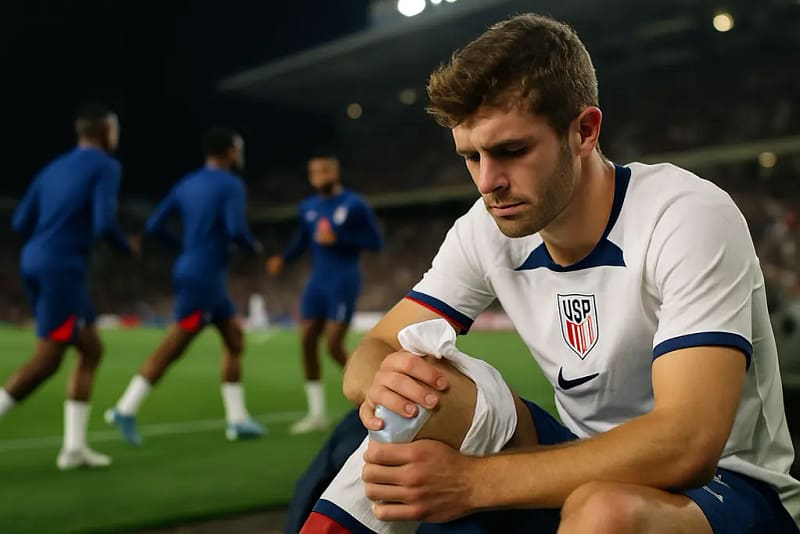
The available injury information points to a front line hit hardest by absences. Christian Pulisic was not included while recovering from a right tibia/fibula bone bruise and microfracture reported after the July 2026 World Cup defeat to Belgium. Ricardo Pepi withdrew from the roster after an injury with PSV. Folarin Balogun was described in the research notes as recently recovered but not fit for selection. Weston McKennie also missed the call-up due to injury, though the available details do not specify the nature of the issue.
What The USMNT Injury Report Changes
USMNT Injury Report: Forward Depth
The clearest roster consequence is at center forward and wide forward. Pulisic, Pepi and Balogun occupy different profiles, but their absences narrow the range of attacking options available across the remaining September 29, October 3 and October 6 matches. Pulisic is a high-usage wide attacker for the national team. Pepi is a penalty-box forward with established senior-team experience. Balogun gives the pool another central-forward option when fully fit.
With those names unavailable, the coaching staff has had to work from a thinner attacking pool during a window that includes Chile, Mexico and Canada after the Peru date. The USMNT injury report therefore should not be read only as a medical update. It is also a roster-construction note, because the absences affect substitution patterns, training workload, and how many minutes can reasonably be distributed across forwards over a short span.
Pepi’s case changed the squad directly. The research notes state that he was withdrawn from the 28-man roster on September 20, 2026, after suffering an injury during PSV’s 3-2 defeat to FC Twente. Damion Downs of St. Louis City was added in his place. The notes also state that Downs is 22 years old, on loan at St. Louis City from Southampton, and has six senior USMNT caps.
Why Pulisic’s Absence Carries A Different Weight
Pulisic’s status sits in a separate category because the available report from July described a bone bruise and microfracture in his right tibia/fibula, with an expected absence of several weeks Yahoo Sports injury update. The key analytical point is not to project an exact return date from that language. It is to recognize that his exclusion from the September and October roster was consistent with a recovery phase that had not yet produced a selection.
For the USMNT, that removes a player who often changes how opponents defend wide areas. Without him, the team’s attacking balance must come from a different mix of ball progression, off-ball movement and central combinations. That does not mean the replacement structure is automatically weaker in every phase, but it is different. A cautious reading is that Pochettino lost a proven attacking reference point while using the window to assess other players.
Roster Balance Without Several Veterans
Midfield Availability And McKennie’s Gap
Weston McKennie’s absence matters because it removes a midfielder with senior international experience from a roster already shaped by a younger age profile. The research notes state that the 28-player squad averages 22 years and 9 months and includes 13 returning players from the 2026 World Cup squad. Those figures support two points at once: this is not an entirely experimental group, but it is young enough that veteran absences change the leadership and game-management mix.
The available information does not give the specific injury details for McKennie, so the responsible analysis stops short of recovery projections. The football effect is still worth separating from the medical unknown. Midfield depth is not only about replacing one player in a lineup. It affects pressing assignments, box arrivals, set-piece roles and the ability to manage physical matches against regional opponents.
For readers comparing roster-building across sports, NBA Playbook offers valuable insights into how injuries can alter a team’s strategy, similar to the current challenges faced by the USMNT.
Returning World Cup Players And Newer Calls
The presence of 13 returning World Cup players gives the staff some continuity, but the absences of Pulisic, Pepi, Balogun and McKennie place more attention on those asked to take on larger roles. That is where this USMNT injury report connects directly to development analysis. A younger roster can gain useful information from expanded minutes, yet those minutes arrive in a context shaped by unavailable starters and rotation candidates.
Downs is the most direct example because his roster path opened after Pepi withdrew. The available research supports his age, club situation and senior cap count, but not a full projection of his likely role. The more careful framing is that he became an added forward option at a moment when the center-forward group had lost Pepi and was already without Balogun.
For a related roster angle, our earlier USMNT September roster read examined how injury absences can push depth players into more meaningful evaluation windows. The same issue remains relevant after the Peru date because three matches were still on the schedule as of September 28.
How The Remaining Friendlies Should Be Read
Chile, Mexico And Canada As Availability Tests
The USMNT injury report matters most now because the remaining fall schedule compresses evaluation time. After the September 26 Peru match, the team was set to face Chile on September 29, Mexico on October 3 and Canada on October 6. That sequence gives the staff only short gaps between matches, which can influence how aggressively players are used and how quickly tactical conclusions are drawn.
Because the research does not provide Peru match details, it would be inappropriate to assess individual performances from that date here. The stronger evidence-based angle is availability. If a player was not on the roster because of injury or recovery, the coaching staff could not use that match to test him. That absence carries forward into the remaining fixtures unless an official roster change says otherwise.
The Mexico and Canada matches carry particular roster value because they are familiar regional opponents. Still, the injury context should temper sweeping judgments. A forward group missing Pulisic, Pepi and Balogun is not the same forward group the staff would evaluate at full strength. A midfield without McKennie is also missing a known senior option. Performances can still inform the staff, but they should be read alongside the availability limits.
What Should Not Be Assumed
Several boundaries are necessary. The available research does not support exact return dates for Pulisic, Pepi, Balogun or McKennie. It does not provide a confirmed diagnosis for McKennie. It does not state that Balogun was ruled out by a fresh injury, only that he had recently recovered but was not fit for selection. It also does not provide the result or player usage from the September 26 Peru match.
That means the USMNT injury report is best used as a status map rather than a prediction sheet. The supported facts identify who was unavailable and why the roster changed. They do not justify firm assumptions about October club availability, longer-term national-team hierarchy or recovery speed.
Selection Pressure From The USMNT Injury Report
The practical selection pressure is clear. Pochettino’s staff entered the fall window without several attacking and midfield options who would normally shape the roster conversation. Pepi’s withdrawal created an immediate change, with Downs added. Pulisic’s recovery kept a leading attacker out. Balogun’s fitness status removed another center-forward candidate. McKennie’s injury absence took away a senior midfielder.
That combination makes the remaining matches against Chile, Mexico and Canada more useful for depth evaluation than for declaring a fixed pecking order. Players who receive minutes during this window may help themselves, but they are doing so in a roster environment altered by injuries. The coaching staff can still learn about pressing habits, chemistry, and role flexibility. The public interpretation should stay measured because several unavailable players have not been part of the comparison.
As of September 28, 2026, the most defensible reading is that this USMNT injury report shows a squad being tested by absences in high-value positions. It does not settle the long-term roster picture. It does explain why the fall friendlies require a careful separation between player performance, player availability and the temporary shape of the squad.