
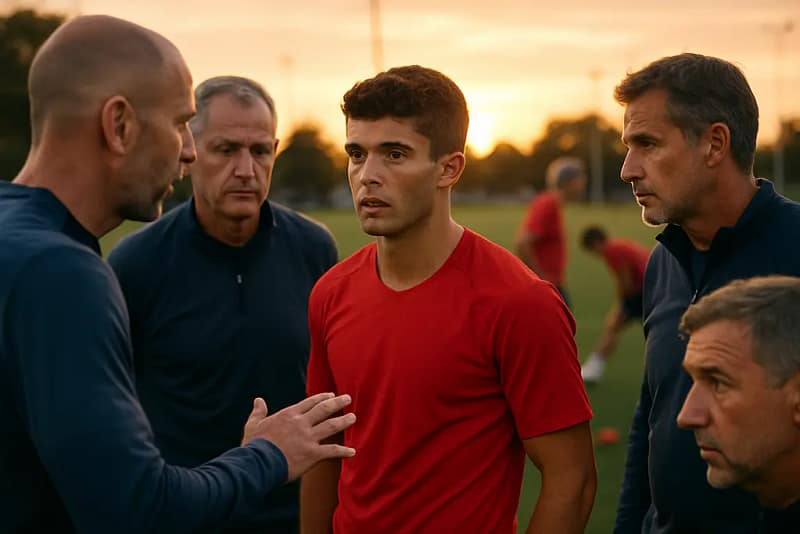

USMNT young talents are the central roster story of the fall 2026 camp because Mauricio Pochettino’s group includes a large uncapped cohort, several teenagers with senior club production, and a few players already moving between MLS, European academies, and first-team environments. As of October 5, 2026, this camp should be read as an evaluation window rather than a promise of immediate senior-team roles.
The confirmed player information comes from U.S. Soccer’s fall-camp profiles, which listed 13 uncapped players and identified matches against Peru, Chile, Mexico and Canada as part of the September-October 2026 window in its uncapped player overview. That matters because a camp with this many first-time senior players is less about one finished depth chart and more about comparing readiness levels across positions, leagues and development pathways.
USMNT young talents In Fall Camp Context
Why The Camp Matters
The most useful way to evaluate this group is by separating confirmed production from projection. Cavan Sullivan, Julian Hall, Zavier Gozo, Peyton Miller and Justin Ellis entered camp with visible attacking numbers at club level. Diego Kochen, Neil Pierre, Adri Mehmeti, Brooklyn Raines and Mathis Albert bring different forms of evidence: youth national-team experience, first-team exposure, academy development, or early senior minutes.
That mix gives the staff several evaluation lanes. The forwards and attacking wide players can be judged on movement, end product, defensive work and decision-making against senior international tempo. Midfielders can be assessed on pressure resistance, spacing and passing choices. Defenders and goalkeepers need a different read: organization, one-v-one defending, distribution, timing and communication often matter more than headline output.
USMNT young talents And The Evidence Gap
There is still uncertainty. Club statistics from MLS or youth setups do not translate directly to senior international football. A teenager producing in MLS has already cleared a meaningful professional threshold, but camp performance depends on training intensity, tactical clarity and how quickly a player processes new assignments. That is why this group should be described with caution: the camp creates evidence, but it does not settle every player’s long-term national-team place.
If you’re exploring related sites within the same network, Efficient Directory offers an extensive guide, but it doesn’t serve as evidence here for player evaluations. For readers comparing this group with the wider squad balance, our related USMNT roster analysis gives the veteran-youth frame around the same fall window.
Attacking Profiles With End Product
Cavan Sullivan And Julian Hall
Cavan Sullivan is the youngest profile in this group and one of the clearest examples of why the camp drew attention. U.S. Soccer listed him as a 16-year-old Philadelphia Union forward receiving his first senior call-up. His 2026 MLS line in the research was 7 goals and 12 assists in 24 matches, with a league record as the youngest player to register a goal contribution in seven consecutive regular-season matches.
That profile is unusual because it combines age, chance creation and scoring involvement. For the senior staff, the key question is not only whether Sullivan can produce a decisive final action. It is whether he can make fast choices under pressure, hold tactical shape without the ball, and avoid being pushed away from useful areas by older defenders.
Julian Hall offers a slightly different attacking case. U.S. Soccer listed the Red Bull New York forward as 17 and part of the uncapped group. His 2026 club production in the research was a club-high 10 goals and 4 assists in 26 MLS games, plus 3 goals in the U.S. Open Cup. He was also identified as an MLS All-Star and the youngest player to score an MLS hat trick.
Hall’s profile is more goal-weighted than Sullivan’s. That makes him a useful camp comparison: one player has a broad goal-assist spread, while the other arrives with a stronger scoring headline. The senior-team question is whether Hall’s finishing and box instincts remain visible when the pace rises and touches are fewer.
Justin Ellis And Mathis Albert
Justin Ellis is another forward in the uncapped group. The research lists him as a 19-year-old Orlando City SC player with 3 goals and 11 assists across all competitions in the current club campaign. It also notes that he was MLS NEXT MVP in 2025 for Orlando’s Generation adidas Cup team.
Ellis stands out less for pure goal volume and more for creative output. Eleven assists across competitions point toward combination play and final-pass value. In camp, that kind of player needs to show whether his service comes from repeatable habits: scanning early, receiving between lines, and delivering before defensive blocks reset.
Mathis Albert, listed in the research as an uncapped Borussia Dortmund midfielder around age 17, represents the European-development side of the group. The available research says he moved from the LA Galaxy academy in 2024 and has been involved in Dortmund’s youth and senior setup. The official-source mirror also includes him among the fall-camp profiles in its fall camp player list. Because the evidence supplied here is thinner than for the MLS attackers, his evaluation should stay narrow: club environment and camp performance are the supported markers, not broad senior-team conclusions.
Wide And Hybrid Players Changing The Evaluation
Zavier Gozo’s MLS-To-Europe Step
Zavier Gozo is one of the most interesting hybrid profiles because the research identifies him as a 19-year-old midfielder or wing-back who signed with Crystal Palace after a breakout MLS season at Real Salt Lake. His 2026 MLS production was listed as 6 goals and 4 assists, with an MLS All-Star selection.
That combination matters because hybrid wide players are judged on two sides of the game. Gozo’s attacking numbers suggest he can affect the final third, but a wing-back or wide midfielder in a senior national-team camp must also defend space, track runners and understand pressing triggers. The move to a Premier League club adds another development context, but the camp evidence should still be the immediate reference point.
Peyton Miller’s Two-Way Case
Peyton Miller entered the research as a New England Revolution defender receiving a first senior call-up. His production line is striking for a defender: 7 goals and 4 assists in 2026. The research also notes that he became the youngest player in Revolution history to sign an MLS contract at age 15 and earned MLS Player of the Matchday recently.
For a defender, attacking output can be valuable but needs position-specific context. If Miller is used as a fullback or wing-back, chance creation and late-box timing may fit the role. If he is evaluated in a more conservative defensive slot, the staff will likely weigh duels, recovery runs and defensive spacing more heavily than goals. Among USMNT young talents, he may have one of the widest evaluation ranges because his statistical profile reads like a two-way player rather than a simple stay-at-home defender.
Midfield, Defense And Goalkeeper Development Markers

Adri Mehmeti And Brooklyn Raines
Adri Mehmeti is listed as a 17-year-old Red Bull New York academy graduate and uncapped senior call-up. The research gives him 1 goal and 4 assists in his first full professional season. It also notes that he represented the U.S. at U-15 level after earlier involvement with Albania youth teams.
Mehmeti’s numbers are modest compared with the forwards, but that is not unusual for a central or attacking midfielder still building professional rhythm. His camp read should focus on technical security, body orientation under pressure and whether he can connect phases of play without forcing low-percentage passes.
Brooklyn Raines brings a different evidence base. The research lists him as 21, uncapped at senior level, with 68 MLS appearances and 50 starts. His 2026 MLS line was 1 goal and 2 assists, but his youth national-team experience includes the 2024 Concacaf U-20 and 2025 U-20 World Cups.
Raines is less of a teenage breakout case and more of a continuity profile. The 68 MLS appearances matter because repeated senior starts can reveal consistency, not just flashes. For the staff, the question is whether that experience translates into quicker decisions and cleaner positioning in a senior U.S. environment.
Neil Pierre And Diego Kochen
Neil Pierre gives the camp a developmental defensive profile from the Philadelphia Union system. The research lists him among the uncapped fall 2026 call-ups and notes 10 MLS first-team appearances in 2026. It also credits him with 4 goals, described in the research as a single-season club record for a defender, and the 2025 MLS NEXT Pro Defender of the Year award.
Pierre’s scoring record is notable, but his senior-team evaluation should start with defending. A center back or defensive player has to show command of spacing, anticipation and physical timing before set-piece or attacking-box value becomes decisive. The award history supports his development track, while the limited MLS appearance count suggests the staff is still gathering senior-level evidence.
Diego Kochen is the goalkeeper case. The research lists him as 20 and on loan at Lyngby Boldklub from Barcelona after a summer 2026 move to the Danish Superliga. It also says he has had a small number of matches because of his club’s defensive struggles, while gaining professional exposure. His youth national-team background is longer, including a 2022 U.S. Soccer Young Male Player of the Year nomination.
Goalkeepers are harder to compare with field players in a short camp. Shot-stopping samples can be noisy, and club context matters. Kochen’s read should center on training quality, distribution, presence, communication and how he responds after defensive breakdowns. Those traits can be visible even when match volume is limited.
USMNT young talents Watch List Takeaways
Who Carries The Clearest Short-Term Signal
The clearest short-term signals belong to the players with repeated senior production. Sullivan, Hall, Gozo, Miller and Ellis all arrived with 2026 numbers that show direct goal involvement. That does not guarantee senior international impact, but it gives the staff concrete evidence to test against the speed and structure of camp.
The next tier is built around role-specific development. Raines has the largest MLS appearance base in the research. Kochen has the clearest goalkeeper pathway. Pierre has a defender-of-the-year marker from MLS NEXT Pro and early MLS minutes. Mehmeti and Albert bring youth and club-development context, with the available evidence calling for a patient read.
How To Watch The Group Without Overstating It
USMNT young talents in this camp should be judged by fit as much as flair. For attackers, watch whether goal involvement comes from repeatable decisions rather than isolated moments. For midfielders, watch tempo control and pressure management. For defenders, watch first positioning before last-ditch recovery. For Kochen, watch distribution choices and command rather than only saves.
This fall 2026 group is valuable because it gives the senior staff a wide sample of modern U.S. development routes: MLS homegrown pathways, academy graduates, MLS NEXT Pro progression, European club moves and youth national-team tournament experience. The supported facts point to a camp rich in evaluation material, but the cautious read is still the right one. The best cases among the USMNT young talents will be built not on age alone, but on how quickly their club strengths hold up in senior international conditions.